

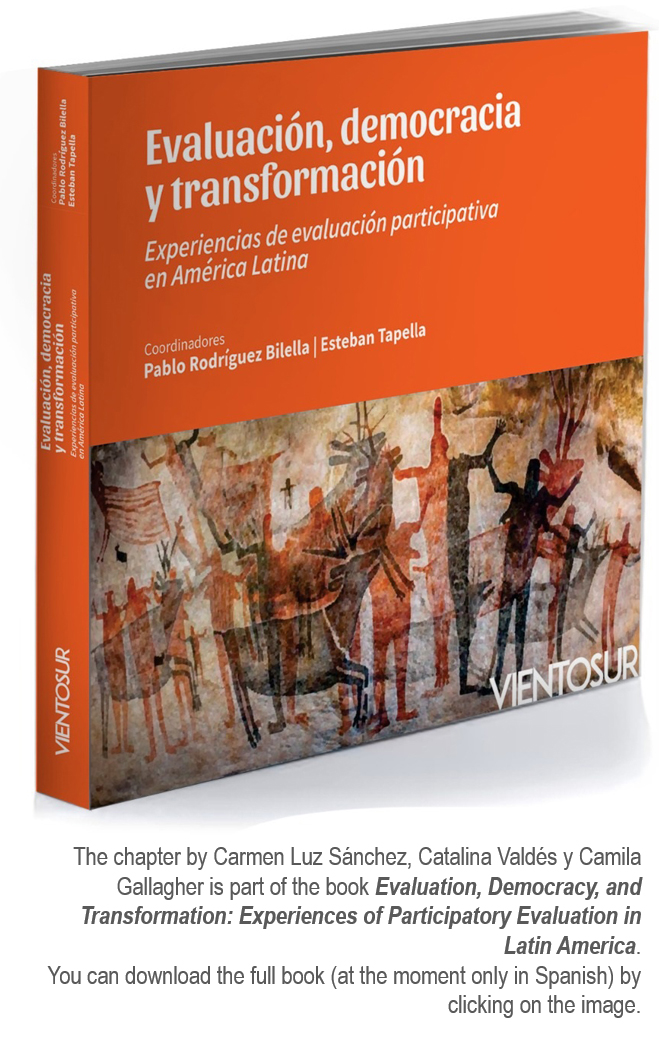
by Carmen Luz Sánchez, Catalina Valdés y Camila Gallagher


More than a technical systematization, this is a profoundly territorial, communal, and transformative experience, which allowed us to explore how evaluation can become a tool for empowerment, collective reflection, and joint action.
The evaluated experience corresponds to a community intervention in the municipality of Putaendo, Valparaíso Region (Chile), within the framework of the Servicio País program by the Fundación Superación de la Pobreza. Putaendo is a rural municipality in the Aconcagua Valley, with scattered settlements, a strong territorial identity, and an active community life. During the 2021–2023 period, the Servicio País team—composed of young professionals who live and work in the territory—spearheaded the intervention to promote a model of local, community-led, and gender-equal tourism development. This model sought to value, protect, and pass on local culture and traditions, respect and preserve the environment, and generate meaningful, territorially rooted employment.
The participatory evaluation was led by the regional Servicio País team and through the creation of an evaluation council with territory representatives, receiving methodological support from the foundation. It was an internal, situated, and participatory evaluation that aimed to highlight both the results and the learnings from the intervention process. Through workshops, interviews, and spaces for collective reflection, the voices of those who participated in the initiative were gathered, building a shared perspective of the achievements, challenges, and future projections of the work accomplished. This experience showed how evaluation, when built from within the territory and alongside communities, can become a powerful tool for social transformation.
One of the central aspects of this experience was the methodological coherence between the program’s approach and the tools used in the evaluation. From diagnosis to decision-making, each stage was traversed by participatory methodologies that recognize and value the knowledge communities have about their territory. This coherence not only strengthened the process’s legitimacy, but also allowed the evaluation to be experienced as a moment of shared learning, rather than an external review.
The evaluation workshops called together diverse actors: from grassroots community organization representatives to the municipality’s own mayor. This interaction among “unlikely peers” enriched the results and opened new possibilities for coordination between local actors. In this sense, the evaluation was not only a technical activity but also an intervention in itself, promoting dialogue, active listening, and confidence building.

The experience in Putaendo demonstrates that participatory evaluation can be both evaluative and interventionist. By actively involving communities, their ownership of initiatives grows, ties among stakeholders are strengthened, and conditions are created for deeper and more sustainable transformation. In this context, evaluating is also about caring, accompanying, and building the future from the present.
We invite those in this learning community to read the complete chapter, available in the book, and to continue sharing experiences that help us envision evaluation as a living, situated, and transformative practice.

