por Susana Menéndez-Roldán, María Dolores Torralbo-Obrero y Salustiano Luque-Lozano
A few months ago, the Practical Guide for Participatory Planning and Evaluation of Public Policies: Mainstreaming Participation (available in Spanish) was added to the EvalParticipativa Resources section. We, Susana Menéndez-Roldán, María Dolores Torralbo-Obrero and Salustiano Luque-Lozano, from the Andalusian Institute of Public Administration (Andalusia, Spain), have written this post to tell you more about this guide.
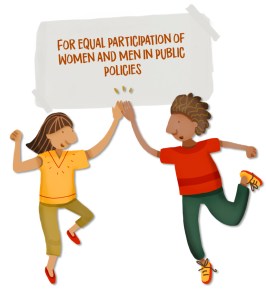

However, the participation of women and men in public policies cannot be fully exercised if adequate mechanisms are not put in place. It is true that anyone can get involved in associations and popular participatory initiatives, but when it comes to public policies, citizens can only take part if they are given the opportunity to do so, along with appropriate governance models and participatory procedures.
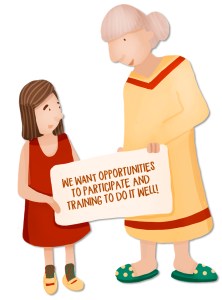

Furthermore, in order to participate, people must feel that their opinion matters and know how to participate through mechanisms and tools that have been adapted to the different groups. It is only by participating fully that citizens learn about the inner workings of politics, and fairer, more democratic, sustainable and long-lasting actions are achieved. This is thanks to the fact that the more someone is involved in something, the more ownership and care they feel towards it, and the more they can learn from the process.
Some institutions are tackling these challenges, including the Andalusian Institute of Public Administration (IAAP), an Andalusian regional government agency (Spain) that has been working for more than five years constructing methodologies and practical tools for public administration policy evaluations, training the staff who work on them and providing help and advice for their application in specific projects. This guide was published at the beginning of 2021 in response to the challenge to implement a realistic governance model where participation is integrated into public policy planning and evaluation. Its most innovative feature is the mainstreaming of co-decision-making participation in administration policies of all levels (state, regional or local) rather than only in local contexts, as is more common, perhaps because of the difficulties inherent in forming teams and attempting to make joint decisions with large populations.


Mainstreaming participation means considering the participation of women and men as policies are planned, and being flexible about what participatory model and method is chosen according to different variables, such as social factors, economic costs, time restrictions, policy objectives, the target population and their needs, the sectors or areas affected by the policy, and the human and technical resources involved in public policy planning. In all cases, it is committed to a methodological coherence that weighs up the advantages of participation, going beyond processes that are merely advisory, seeking to mainstream gender-sensitive participation at all stages of the public policy cycle.
The guide is organised into three sections:
The first section introduces the general regulatory framework that underpins the right of citizens to participate in public policies. It presents participation as a pillar for strengthening democracy and empowering individuals, and sets out the advantages offered by participation to improve policy planning, implementation and evaluation.
The second section explains methodological concepts, participatory models and proposals for mainstreaming participation throughout the public policy cycle in a way that is flexible, adaptable and proportional to the aim, degree of joint activity, diversity of staff and other individuals, circumstances, contexts, resources and policy cycle phases. This section is divided into two sub-sections for methods, one for participatory planning and the other for participatory evaluation.


The third section includes a large repertoire of participatory tools and useful tips regarding how to select, prepare, implement and adapt them to the target audience and context. It also discusses how each tool can be used in different phases and for different purposes, proposing variations and links to examples. It is worth highlighting the stakeholder mappings that take into account gender intersectionality, the choice of population samples and tools for decision-making, which are innovative in the context of supralocal administrations and will be of great help to incorporate participation in each phase. It also includes a list for self-evaluating and reviewing participation in the different phases of a public policy cycle.