Today we would like to share an article by Leonardo Drazic (*) with the EvalParticipativa community. He is one of our friends and colleagues at the National University of San Juan and has supported this initiative in various ways since it began. Leo shares with us some thoughts that we consider relevant for the approach to participatory evaluation that we promote. An approach that holds the democratic ideal at its core and that focuses on the importance of citizens being the political reason behind every evaluation. Particular emphasis is placed on the higher education system and the need for it to connect to reality at different levels.


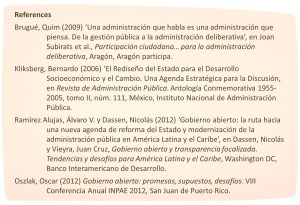
Such uncertainty is due primarily to a citizen participation “crisis”. Citizen participation should be a relevant instrument for improving the population’s living conditions. Instead, decisions are made by bureaucratic governments that are distanced from citizens and that regularly dismiss providing opportunities for civil society to have control over public mandates. Given the above, society is only democratic to a certain extent. Democracy has appeared to be the model that humanity has most often chosen to promote a fairer society and a more equal distribution of income. However, moving in this direction requires a complete redesign of how the state operates (Klilksberg, 2006: 820).


To this end, citizen participation should be promoted in public affairs through institutional mechanisms. It should be an unavoidable and non-delegable government obligation to guarantee civil society has opportunities to affect the way the collective destiny is defined. The permanent inclusion of society in all formal decision-making moments that define the public agenda should neither be left to a small group of economic stakeholders, nor to market desires.
Citizen participation is understood as a value-based social and historical construction that guarantees rights and duties with a state that is capable of putting in place inclusive policies. In this regard, government organisations should drive public debate and provide information channels and spaces for consultation that lead to a more effective, innovative and responsible public management that holistically fulfils society’s basic needs (Ramírez and Dassen, 2012: 51). Citizen participation should be integrated into the different levels of government (municipal, provincial and national) as an effective right and its legal framework should be explicitly defined as beyond any political transitions.


…..