

by Carmen Lucía Jaramillo


Beyond discourses on empowerment, horizontal relationships and recognition of the value of the knowledge and experience of local actors, it is always challenging to combine the demands of methodological rigour (structures, formats and technical language) and the need for fluent communication with protagonists in the transformation of the challenging realities they face in their territories. Generally speaking, structural socio-economic problems and indifference on the part of those in power are standard features in such environments. That is why it is always a challenge to “[…] create a space for debate, that is, a truly respectful space. Not the simple tolerance derived from indifference and scepticism, but a positive appreciation of differences” (Zuleta, 1985).
For this reason, in this continual pursuit of in-depth analysis and debate based on the use of simple language, I often opt for methods rooted in analogies that are familiar to the contexts and daily lives of the people with whom I carry out participatory planning or evaluation. One of the analogies that I have been able to adapt to multiple situations is that of a journey in a chiva, a form of transport used in rural Colombia to carry both passengers and goods. The image of the chiva is also very useful, because each one is a unique representation of what its owners want to say about their region. This is why they are covered in colourful images as a hallmark of pride and identity.
The tool and its use
First used in a planning exercise in 2009, this image was an idea that emerged from a collective process in the Colombian Ministry of Agriculture’s Oportunidades Rurales (Rural Opportunities) programme. On this occasion, we needed to reach concrete agreements with rural small business owners on strengthening projects for whose design, financial management and evaluation they themselves would be responsible for. A few years later, with the knowledge that it had worked well before, I proposed adapting the exercise for the Colombian Ministry of Science, Technology and Innovation’s A Ciencia Cierta programme, which continues to use it in planning, monitoring and evaluation processes.
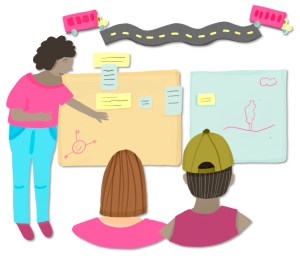

These are some examples of how we have used these analogies to encourage collective reflection in a creative and profound way. Discussions based on these images facilitate the use of shared language based on the lived experiences of all participants. Rather than educational background, it is clarity about what it is hoped to achieve that matters: familiarity with the territory and experience in community work and in working jointly with institutions. The comparison also permits reflection on the importance of maintaining control over the project, as the institutions are only there to provide support: a fundamental but temporary role. The real protagonists in their own development -and the ones who will “suffer” the concrete results that may or may not be obtained- are the local inhabitants and organisations.


The analogy of the vehicle and road also proves useful in another experience: participatory evaluation. In the next example, it was not specifically suggested to use the image of the chiva. Instead, participants were given the freedom to make their own choice of vehicle and describe the road on which they had travelled. This evaluation assessed the work carried out by five organisations in Caquetá (Colombia) as part of the ProPaz (ForPeace) programme (financed by GIZ), which sought to strengthen civil society capacities to improve governance.
A workshop was held with the five organisations and each was asked to use drawings to reconstruct the implementation process of the project and the particularities of each organisation. The instructions specified that the road represented the context, the vehicle the organisation, and that along the way, they were to draw plants to symbolise the results that had been made available to other people in the territory.
Thus, in an enjoyable collective exercise, the participants were free to let their imaginations run wild and they created images that represented their perceptions and feelings about the project’s journey. These are some of their reflections that captured, clearly and in concrete terms, the progress, difficulties and changes that occurred.
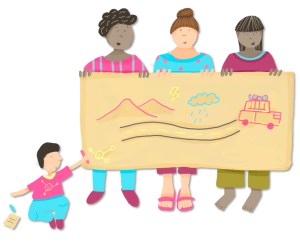

Despite these difficulties, as members of the Cristo Rey JAC, they planted the seeds of long-term processes, such as organising access to electricity supplies and opening a new road. This was represented by fields of crops of medium- and long-term yield such as cacao and rubber. With the implementation of the project and the support of more than nine institutions, they managed to “repair the vehicle”. In other words, they rejuvenated the JAC by updating its formal documentation, so they could sign contracts for work to benefit the community and manage new projects, convincing 25 families to work together.
Gradually, the road improved (the context began to change) and it was possible to travel together in a better vehicle that found places to refuel, as well as other people to share with at stops along the way. The achievements obtained as a result of their efforts were depicted in the drawing (represented by the fruits from the trees included in the drawing), highlighting that 14 families had been connected to the electricity supply, 4.7 km of new roads had been opened and the work on the community water supply had begun. Today, Cristo Rey is a model community in terms of strength and unity, with the capacity to develop social and productive projects.
Another organisation consisted of 16 women with a garment business, located in an urban area. They had received a lot of institutional support in terms of their productive activity, but the project introduced them for the first time to issues related to claiming rights.
They represented the initial period with a small vehicle with no lights, thus symbolising the lack of organisational vision, despite the fact they had the means of production. A “pothole” in the road was the low levels of training of women, to which was added the “broken bridge” of machismo. Despite the many difficulties, they decided to “board the strengthening processes bus” and seek collective transformations, which they depicted as the planting of a forest. A vehicle with new tyres appropriate to different terrains (actions) symbolised this organisational change. They also “spruced up the car”, saying that they are now women who have a clear direction and are more empowered. In their drawing, they represented the strength they feel and the fact that they now have knowledge that is important to their role, not only in the productive sphere (with their new designs) but also for their social demands. They represented their achievements by drawing a field of flowers.
The exercise carried out by this group of women allowed them not only to identify the achievements of the project and the difficulties encountered during its implementation, but also to recognise their own transformation as a group. They highlighted the value of incorporating advocacy for women’s rights in their productive activity, thus shifting the focus of their work as an organisation to a more holistic approach, expressing a sense of renewal as they brought together economic and socio-political elements.
Lessons from this tool
These examples show the potential of using analogies that are familiar to people’s everyday experiences to spark reflection, generate debate and reach agreements. It might be said that the approach is based on the same premises as lateral thinking, where established patterns of thought are broken and new alternatives sought to analyse reality and find novel, creative responses to challenges. It also helps to break down rigid, polarised ideas that can become established in human groups by forcing people to step out of their roles and think creatively.
Practical tools for participatory processes of planning and evaluation with communities offer opportunities to facilitate their active involvement in decision-making about the direction interventions should take. As Grundmann, G. and Stahl, J. (2002, p.8) state, “[…] methodological procedures express predispositions and positions: when we decide on the application of a certain procedure, we simultaneously hinder or promote participation, equity, empowerment, sustainability. The tool or procedure we choose guides us in our basic attitudes towards recognising and negotiating the diversity of interests.”
The following testimonial video (in Spanish with English subtitles) provides a description of the tool and its use in participatory approaches.


References
Grundmann, G. and Stahl, J. (2002). Como la sal en la sopa. Conceptos, métodos y técnicas para profesionalizar el trabajo en las organizaciones de desarrollo. Editorial El Búho. Bogotá,D.C.
Zuleta, E. (1985). Tribulación y felicidad del pensamiento. In: Sobre la idealización en la vida personal y colectiva y otros ensayos. Procultura, S.A. Bogotá