by Jorge Chavez-Tafur
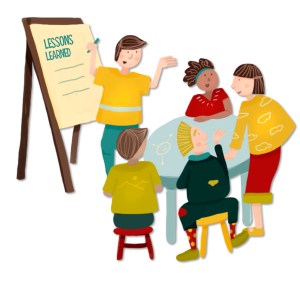

As in a systematisation process, this approach is believed to help identify specific innovations and practices, and -above all- to understand the reasons behind their successes or failures. One of the major benefits of an experience capitalisation process is that it involves all those who are -or were- part of the experience.
But how do we promote such a process, and what are the steps to be followed? And once we have decided to go ahead, how do we facilitate the participation of different people? These were some of the questions that we asked ourselves at the Technical Centre for Agricultural and Rural Cooperation (CTA) about five years ago, prompting us to initiate a project together with the Inter-American Institute for Cooperation on Agriculture (IICA) and the United Nations Food and Agriculture Organization (FAO). Financial support was provided by the International Fund for Agricultural Development (IFAD). From 2016 to the end of 2019, the project responded to the need to develop specific skills for describing and analysing specific experiences, identifying and disseminating lessons and recommendations, and putting these to use. Working in different parts of the world and focusing on analysing the steps that should be taken in processes of this kind, the project sought to encourage the adoption of a capitalisation process at different levels. To this end, we sought to capitalise on the experience we had embarked upon, to learn lessons about the process itself and to validate the approach followed.
What we did?
Initially, our activity focused on East Africa, before expanding to Asia and Latin America. In each region, we organised several processes in which we followed the “learning by doing” approach rather than merely talking about experience capitalisation. Thus, alongside multiple capacity-development workshops, one of the strategies involved the formation of a community of practice, involving everyone who participated in the courses and workshops. We were interested in complementing the face-to-face discussions that took place in the workshops and enabling an exchange of information between participants from different regions. In this community of practice, a sub-group was created for the exchange of ideas and information in Spanish.
Discussions focused on the need for detailed descriptions and the importance of analysis, and exploring the reasons behind the results (or their absence). But we did not concentrate only on looking back: one aspect reiterated throughout the project was the need to pay special attention to the adoption or “use” of the results of a process of this kind. Both the workshops and the online discussions revealed the importance of developing action plans and sharing lessons learnt along the way with a specific target audience. A communication expert helped us create a system for identifying target groups and selecting the best products and methods to reach them.
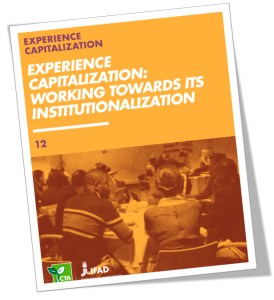

Next, a detailed plan was prepared that included specific activities, the names and responsibilities of everyone involved, and the resources required. Many participants put their plans into action, and the results were presented in one of the project’s final activities: the book “Experience capitalization: Working towards its institutionalization”, which features 25 case studies and describes what was done and what was achieved.
Validating a methodology
As with any project, the CTA commissioned an external evaluation process which sought to measure activities and results, and extract specific lessons that might serve as concrete recommendations. However, the most interesting process was the ongoing analysis of the activities and immediate results. The idea of capitalising on our experience capitalisation processes (a kind of “meta-capitalisation”) allowed us to identify the similarities and differences between the different groups involved.

Naturally, the case studies indicated that each process was different, depending to a large extent on the specific context in which each workshop was held and the individuals who took part. Yet the principal elements of the approach were evident in each case, and a process of reflection helped the participants identify steps or ideas to facilitate the description and analysis of a particular experience in detail. More importantly still, they helped identify why these steps or ideas worked. We discovered, for example, that organising face-to-face workshops in each region is not always efficient (and is at times impossible). Another common difficulty was the length of the documentation and publication process, which further delayed the activities planned to boost the adoption and institutionalisation of the process.


Facilitating online discussions introduced another challenge. Even though we had over five hundred people listed as members of the community of practice, most discussion centred around the preparation of face-to-face workshops. It was often difficult to get members to participate more actively, even though we tried to address this by organising a course for online facilitators and by identifying “lead facilitators” in the different regions.
Results
While it is difficult to demonstrate the results of a project after a relatively short period of time, three years on we can already say that the project is displaying positive results: we were able to complete more than 120 experience capitalisation processes with more than 450 participants.

Most significantly, the experience has validated the approach taken and confirmed the need to follow specific steps. The process we followed showed that we should continue to support and strengthen the community of practice and support the champions who are now responsible for facilitating processes in the different regions, and that we need to improve the links with existing monitoring and evaluation processes already used by projects or organisations. More broadly, it revealed what works and what does not in the facilitation of an experience capitalisation process. On this basis, we were able to make specific recommendations.
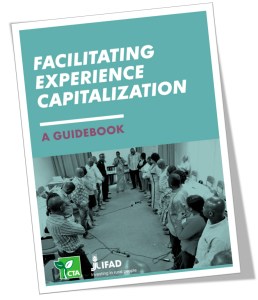

The principal lesson, however, is that “learning by doing” is far from being an approach that must be followed to the letter. Each process will be different and facilitators should adapt their work to the context and participants in question. This requires in-depth prior preparation, but also the ability to continually improvise and adapt plans. Only in this way will it be possible to ensure the involvement of all participants, develop their capacity, and provide support and motivation -all aspects that are crucial if the work is to produce helpful results. It is vital that “learning by doing” processes continue and that they generate new lessons and recommendations that will inspire other facilitators. Our job now is to continue to document and share all this.