by Alba Ximena Zambrano Constanzo, Vaite Trujillo Burgos, Mauricio García Ojeda, Francisca Román Mella


The article is part of a broader comparative study involving five urban neighbourhoods: three in Chile and two in Brazil. This publication focuses specifically on the Chilean cases, developed in the city of Temuco, in the La Araucanía Region, areas marked by socio-spatial segregation, urban precarity, and a historically unequal relationship with public policy.
Drawing on community psychology, the study explored how three key dimensions of community strengthening are connected in everyday neighbourhood life: sense of community, social capital, and empowerment. But beyond the findings themselves, the main contribution of the work lies in how and why the evaluation was carried out.
Participatory evaluation was not understood as a final stage of measurement, but as an ongoing process of dialogue, interpretation, and feedback, in which residents took an active role not only by contributing information, but also by discussing the findings, questioning interpretations, and collectively recognising their strengths and limitations as organised communities.


The social network analysis, which formed part of the participatory process, also showed that social capital circulates in a fragmented way and is concentrated within specific groups. This limits the ability of neighbourhoods to build broad collective agendas and to influence, in a more structural way, the policies affecting their territories.
These findings were not presented as closed diagnoses, but were discussed collectively through feedback sessions, workshops, and community meetings. In this process, the evaluation itself became a strengthening tool, creating spaces for recognition, critical reflection, and collective learning.
From a classical perspective, social evaluation differs from research because it focuses on a clearly defined ‘evaluand’ — that is, what is being evaluated — usually a programme, project, intervention, or policy. In this study, however, the object of evaluation was not a standardised intervention or a formally delimited programme, but rather the community strengthening processes developed within the neighbourhoods. These were understood as socio-historical trajectories of organisation, participation, and relationships with the State, many of them linked, explicitly or implicitly, to public policy mechanisms and previous territorial intervention experiences.
In this sense, the evaluation is conceived as a process evaluation aimed at analysing how key dimensions of community strengthening — sense of community, social capital, participation, and empowerment — are configured, sustained, or constrained in urban contexts marked by structural inequality. Rather than measuring predetermined outcomes, the evaluation seeks to understand how these dynamics operate in practice, what effects they have on the organisational and political capacity of communities, and to what extent they enable or restrict collective agency.


METHODOLOGICAL BOX
How was the participatory evaluation carried out? The evaluation was designed as a mixed, progressive, and dialogic process, combining different strategies:
-
-
- Building relationships and trust: long-term work within the territories, participation in community activities, and clear agreements about the purpose of the evaluation.
- Participatory production of information: interviews, participant observation, collective workshops, and group discussion spaces.
- Quantitative tools serving the process: scales measuring sense of community and social network analysis, used not as ends in themselves but as inputs for collective reflection.
- Feedback and co-interpretation: presentation of results to communities, open discussion of findings, and contextual validation of the analyses.
- Inter-neighbourhood meetings: spaces for sharing learning between communities, identifying common challenges, and strengthening networks beyond the neighbourhood itself.
-
This approach allowed the evaluation not only to describe community dynamics, but also to activate processes of epistemological empowerment, expanding communities’ capacity to interpret their own reality.
TRANSFERABLE METHODOLOGICAL LESSONS FOR PARTICIPATORY EVALUATION
Based on this experience, the article offers relevant lessons for those designing and carrying out participatory evaluations in community contexts:
- To evaluate is to intervene: every evaluation generates effects. Recognising this makes it possible to design ethical processes that are consistent with community strengthening.
- Participation is not just consultation: it means involving communities in interpretation, not only in data collection.
- Tools matter, but the process matters more: questionnaires and network analysis can be powerful when integrated into spaces for dialogue and feedback.
- Time is a methodological condition: trust and collective reflection require long-term processes and sustained presence.
- Feedback is a central part of evaluation: not an administrative closing stage, but a political and educational space.
- Community strengthening is relational: it does not depend on a single dimension, but on how relationships, leadership, participation, and links with the State come together.
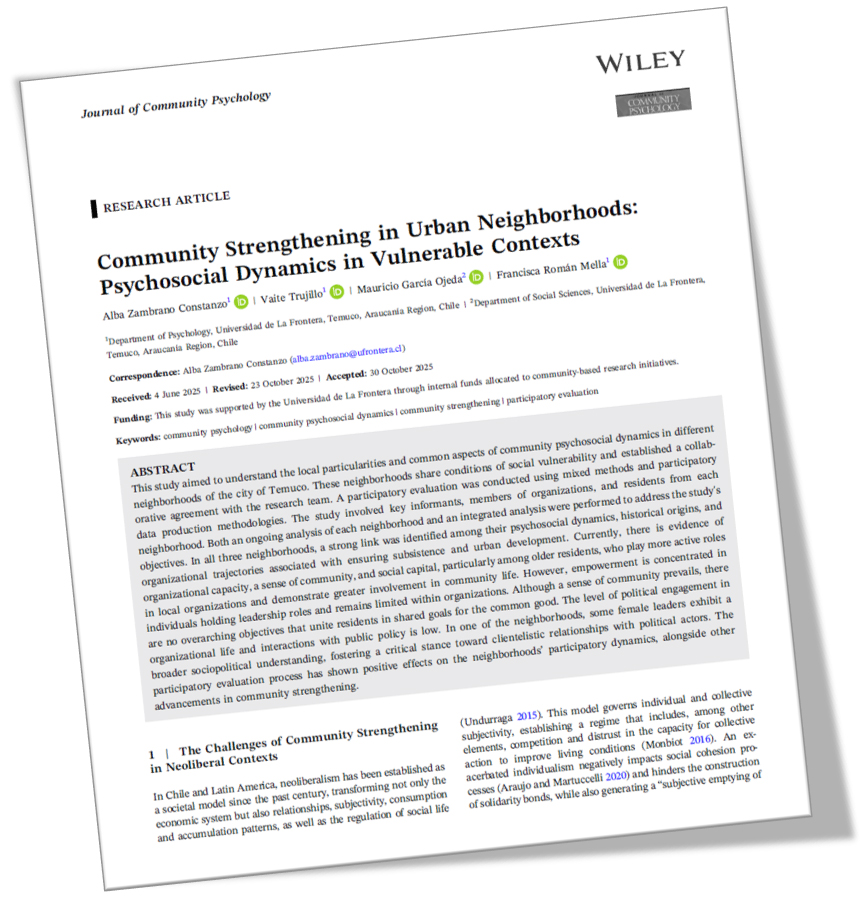

We invite evaluators, community teams, and organisations to read the full article and engage with its proposals. Rather than offering ready-made formulas, the work aims to contribute to a situated, critical, and committed participatory evaluation focused on strengthening communities.