A game to evaluate the quality and performance of an intervention
by Vanesa Castro

We present here this new creation of EvalParticipativa, a game that promotes a collaborative atmosphere in which every voice is heard and valued, and in which the active participation of everyone is essential for learning and continual improvement of our interventions.
Participatory evaluation, which this playful approach facilitates, is fundamental to any intervention. In addition to identifying a project’s strengths and areas for improvement, the game helps everybody involved to deepen their understanding of the intervention and empowers them during the process. Thus, the Evaluation Expedition not only fosters reflection and dialogue, but also offers a clear perspective on how to develop an intervention and what aspects could be optimised to ensure greater impact.
What is the purpose of the game?


Along the way, they are asked key questions on the project’s relevance, effectiveness, efficiency, impact and sustainability. At the end of the game, the participants will have generated shared lessons that enrich the intervention, benefitting all those involved.
When should it be used?
This game is useful at different stages of a project or programme:
- During the planning and design phases it helps analyse the relevance and feasibility of an intervention, ensuring alignment with the needs of the community.
- During the implementation phase it facilitates progress evaluation and helps define areas requiring adjustment, ensuring that the project stays on track.
- In the closure phase it helps evaluate results and extract lessons, which is essential for future interventions.
Game format and materials


The players have a set of instructions that explain how to carry out the activity, question cards, a response grid for recording answers and scoring the answers given, and counters which show the group progress on the board.
How to play
Before the game begins, the cards are grouped by criterion and placed on the corresponding animal areas. Each criterion is represented by a wise forest animal.
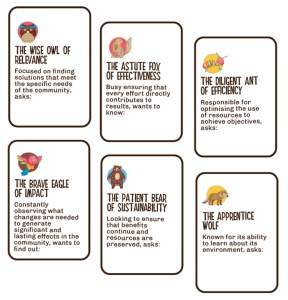

The next animal area is that of the fox, which represents effectiveness. During this stage, the players evaluate the extent to which each effort directly contributes to the expected results. The players then move on to the ant square, which personifies efficiency. Here, the group analyses how they use (or have used) the resources to reach their objectives in the best way. Next, they go to the bear square, which embodies sustainability. Here, they reflect on the likelihood the benefits and resources will last over time. Finally, the group finds itself at the apprentice wolf square, which symbolises learning. Here, the players reflect on the capacity of the project to learn from its environment and adapt to new challenges.
The game ends when the journey has been completed or the group decides to stop. At the end of the activity, the group reviews the answers and the scores assigned, identifying areas that need more attention or information. This final reflection is key to applying lessons learned to future interventions.
Recommendations
To make the most of the game’s potential, it is important to include representatives from a wide range of stakeholders associated with the project, such as the beneficiary population, the implementation staff, leaders, local partners and evaluators. Broad representation guarantees a richer, multidimensional evaluation.
The success of the Evaluation Expedition also depends to a large degree on the quality of the participation. It is of vital importance that enough time is allocated so that participants can dialogue calmly, express their ideas and reflect deeply on the questions asked in each area. This fosters an environment of trust and collaboration which is essential for reaching agreements and generating meaningful learning.
The questions can be adapted to the specific characteristics of an intervention. In other words, you can prioritise the question cards that deal with specific topics or areas of particular interest. Thus, the game can focus on the aspects that are most relevant to a project. This customisation helps guide the debate to address critical points that need to be explored in depth.
At the end of the game, we recommend the group dedicate time to reviewing and reflecting on the answers and scores assigned. It is important to identify areas that require more attention or information so that the lessons learned can be applied to future interventions. Furthermore, this shared review process supports joint learning and strengthens the capacities of all participants.

MATERIALS NEEDED TO PLAY THE GAME
To use this tool, you have to download the materials by clicking on each element of the game. Next to the links, we suggest you how to print each element.
FOLDER AND BOARD. The board is also the folder of the game. You have to print it in A3 format, 250 grams paper, preferably in colour. CARDS. The cards must be printed in A3 format, 250 grams paper, preferably in colour. Remember that you can adapt the questions according to the type of intervention and the purpose of the evaluation. INSTRUCTIONS. This document can be printed in A4 or letter format, in black and white. MATRIX OF QUESTIONS AND ANSWERS. This document can be printed in A4 or letter format, in black and white.