 One of the challenges evaluators face when pursuing participatory evaluation is the need to create real spaces for participation, in which multiple actors can have a real say in the evaluation agenda. Evaluators must therefore be able to identify and use appropriate tools for each social and cultural context of the evaluation process. These tools may be used to analyse a situation, facilitate communication, build shared perspectives, stimulate creativity, facilitate decision making, or reduce the dominance of some participants in order to allow quieter voices to be heard. Their use is of increasing importance in this type of evaluation.
These participatory techniques consist of specific instruments or tools that make each step of the evaluation process feasible, guaranteeing the greatest possible involvement of everybody involved. The tools may consist of a combination of activities such as group exercises, sociodramas, adaptations of popular games, puppets, drawing, puzzles, or any other method that helps achieve the high-quality participation of the many actors involved in the evaluation process. Whether a group interview, a round table, a conference, the use of a flip chart with illustrations, a simulation game, a group activity or a video debate, we can use a wide variety of tools, as long as they are adapted to the topic, the characteristics of the group and the proposed objectives.
In this section, we will identify and document participatory techniques created by members of the EvalParticipativa community, which have been used in different contexts, with different groups of social actors and for different evaluation purposes. For each tool, we provide a fact sheet, links to download the material in PDF and a teaching video which describes the tool and the way it can be used.
1. THE ‘CHIVA’
 A tool to facilitate the planning, monitoring and participatory evaluation of projects. This tool was designed within the framework of the Oportunidades Rurales programme of the Colombian Ministry of Agriculture, and was further developed within the framework of the A Ciencia Cierta programme of the Colombian Ministry of Science, Technology and Innovation. Click here to access to technical description and video of this tool.
2. GAME: MYTHS AND BELIEFS ABOUT CANCER
 A game to aid reflection on what we do and do not know about this disease. The tool was designed to evaluate the Cancer Prevention and Treatment Services in Valle de la Estrella, in the Limón province, Costa Rica. This participatory evaluation was promoted by the Foceval initiative of the German Institute for Development Evaluation (Deval) together with the Costa Rican Ministry of Planning and Economic Policy (MIDEPLAN), with the support and participation of the Costa Rican Office of the Ombudsman (Defensoría de los Habitantes de Costa Rica) and the Costa Rican Social Security Fund (CCSS). Click here to access to technical description and video of this tool.
3. use of DRAWING AND DIAGRAMMING to CAPTURe MULTIPLE PERSPECTIVES IN HIGHLY VULNERABLE POPULATION GROUPS

This tool is about how to capture multiple perspectives using the drawing and diagramming technique. This tool has been employed with highly vulnerable population groups in fragile and volatile social contexts. In this article, Emma Rotondo describes three case studies and then offers some recommendations on how to incorporate the technique into individual interviews, focus groups and workshops within the framework of a programme evaluation or experience systematisation. Click here to access to technical description and video of this tool.
4. The ‘Periodic Table’ of Evaluation
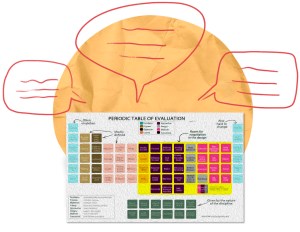 The ‘Periodic Table’ of Evaluation is a tool that, in the form of a visual catalogue, provides an understanding of the main parameters and methodological choices present in an evaluation design. As evaluation is a wide field of methods and designs in continuous development, understanding in a simple visual tool the numerous parameters and choices associated with the different methodological options can be of great help for evaluation practice. Access to technical description and video of this tool at this link.
5. PARTICIPATORY EVALUATION MAZE. A GAME TO ENCOURAGE THINKING
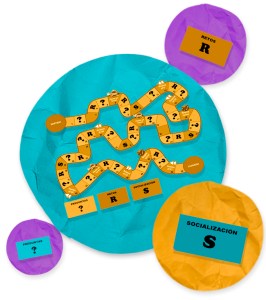 The tool was developed to aid reflection on a completed evaluation experience including the lessons learned, difficulties and challenges faced and potential uses of the findings. This retrospective approach is intended to generate relevant reflections for those who wish to carry out similar processes. This tool was designed at the end of the participatory evaluation of the Cancer Prevention and Care Services in Valle de la Estrella, in the Limón province, Costa Rica, carried out in 2016 and 2017. Click here to access to technical description and video of this tool.
6. WHAT SHALL WE EVALUATE? EVALUATION QUESTIONS
 Question formation is one of the most critical points in the evaluation process. This is what determines where we look for the information required to gain understanding on the intervention. It therefore also impacts the quality of the recommendations put forward to improve the programme or project.
The game ‘What Shall We Evaluate?’ is a tool designed to aid the formulation of sensitive and profound questions in a participatory, non-hierarchical and non-imposing way. You can read more about the game and watch the video presentation here.
7. PROJECT TRAFFIC LIGHTS
 This tool was designed to carry out an ex-ante evaluation of a project, analyse its feasibility and guide its redesign. The game facilitates the review and critical analysis of a project, addressing the main variables or feasibilities that, according to the type of intervention, are most relevant.
The game is mainly intended for representatives of the target group or target population, members of the supporting entity, representatives of the organisation financing the project. Click here to access to technical description and video of this tool.
8. EVALUATION EXPEDITION: THE INTERVENTION FOREST
 Evaluation Expedition is a game to evaluate the quality and performance of an intervention, a participatory tool that invites all the actors involved in a project to embark on a journey through a symbolic forest that seeks to represent the complexity of a programme or project. Throughout this journey, participants will face challenges and answer key questions that will allow them to reflect, discuss and evaluate their intervention in a comprehensive way. Click here to access to technical description and video of this tool.
9. QUESTION DICE. A TOOL TO HELP PEOPLE TALK ABOUT THEIR PROJECTS
 This tool seeks to make the Theory of Change of a project explicit, sharing the perception of the project from the point of view of different social actors. It is an excuse, articulated in the form of a game, for the participants of a programme/project to reflect on the essential questions surrounding the intervention. Click here to access to technical description and video of this tool.
10. CONCEPTUALISING PARTICIPATORY EVALUATION
 Here we offer two tools to facilitate the construction of a shared conceptual framework around Participatory Evaluation. These tools were designed within the framework of EvalParticipativa’s capacity building strategy, and are aimed at project leaders, socio-cultural animators and professionals working in the field of programme management and evaluation. Click here to access to technical description and video of this tool.