by Andrea Meneses Rojas
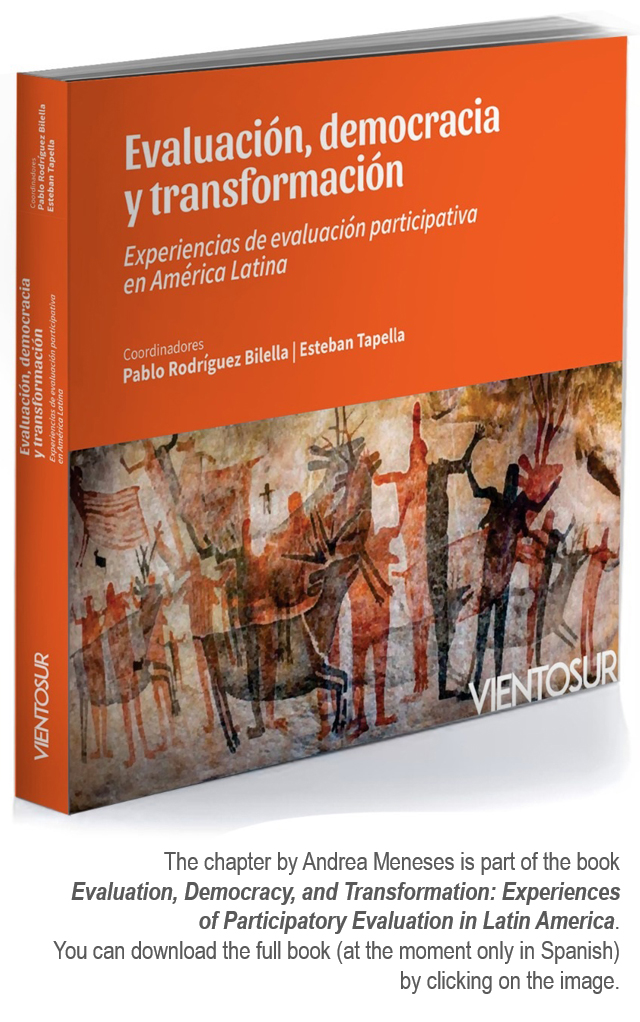
 In Chapter 13 of the book Evaluation, Democracy, and Transformation, I invite you to explore how, over ten years of international cooperation, diverse intentions and shared learning have come together so that participatory evaluation has moved from being a mere ideal to becoming a transformative practice in Latin America and the Caribbean.
Throughout this decade, cooperation between the German Institute for Development Evaluation (DEval) and Costa Rica’s Ministry of National Planning and Economic Policy (Mideplan) has established participatory evaluation as a strategic commitment in actions carried out in the region. Between 2014 and 2024, this joint effort was channeled through two projects (Foceval and Focelac) with a common purpose: to strengthen evaluation capacities and contribute to evidence-based decision making.
 In the first section, I illustrate how, starting in 2014, various actors—including public institutions, academia, civil society, and international cooperation—began to come together around the notion that evaluation should not be a closed exercise, by and for specialists, but rather a shared, inclusive space fostering mutual learning. The chapter traces key moments: the creation of the Coordination Group in Costa Rica, the formation of multi-stakeholder platforms, the first pilot experiences with participatory evaluation, and later, the consolidation of regional initiatives such as the EvalParticipativa community, which today brings together individuals, entities, and organizations from all across Latin America and the Caribbean around this subject.
The second part recounts the path taken: the major milestones, concrete experiences, and pilot practices that not only built capacities, but also demonstrated in practice the value of including more voices in evaluation processes. Here, the systemic approach to cooperation promoted by DEval is brought to light—an approach that aimed for impact on three levels: development of individual capacities, strengthening of institutional capacities, and creation of a more favorable environment for participatory evaluation in the region.
In this section, I highlight concrete experiences that are explored in depth throughout the book—from participatory evaluation in Limón, Costa Rica, to supported processes such as Servicio País in Chile, Evalúa Jalisco in Mexico, the National Secretariat of Planning in Ecuador, among others.
The third section is devoted to lessons learned and challenges—not only the achievements, but also the tensions and limitations encountered along the way: how to support organizations moving at different paces, how to balance the need for results with the commitment to more inclusive processes, and how to navigate the region’s often complex and shifting political and social contexts. This section also offers some reflections on the contribution of participatory approaches to advancing the 2030 Agenda and the Sustainable Development Goals (SDGs).
 Finally, the chapter looks ahead. What are the next steps for cooperation? A new door opens: the potential for generating new South-South-North synergies, fostering encounters and horizontal exchanges of experience and learning among countries with similar contexts. This connection would enable deepening of more inclusive evaluation approaches, directly impacting public management and the major challenges of global development.
In short, this chapter is an invitation to join a collective learning process within the framework of international cooperation, showing that participation in evaluation is not an abstract ideal, but rather an embodied practice that transforms how we think about, conduct, and use evaluation for the common good.