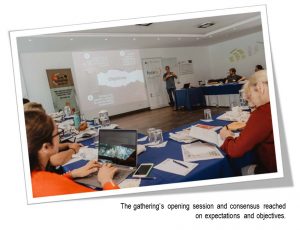
One of the most eagerly awaited sessions began with a challenge for those participants who arrived late: to carry out the Make an Eight forfeit, which involved drawing a figure of 8 with their bodies. This was a fun way to start our discussion on the following question: “What are we talking about when we refer to facilitation and facilitators?”.

Using a kinaesthetic version of multiple choice, the participants decided between true and false options regarding evaluation matrices, questions, social action theory, sources and tools.
Jorge Chávez–Tafur ran the session for facilitators and invited us to use introspection and hindsight to evaluate our own practice. He also took us on a tour of accepted international definitions of the term facilitation, which included entries as varied as yanapai -a Quechua term which means help- and Voorlichtingskunde -which alludes to the science of “lighting the way” in Dutch-. Taking into account the diversity of names, which at times shared little in common, he insisted that rather than agree on terms, the important thing was to capture all that they covered: content, effects and impact.
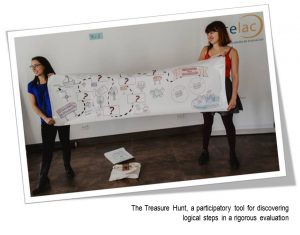
 The motivation behind this gathering is in part the recognition that there already exists a diversity of participatory evaluation experiences in Latin America and the Caribbean. Our open call was widely accepted and we have selected 16 experiences of this type of evaluation which we think reflect the great diversity and richness present in our region.
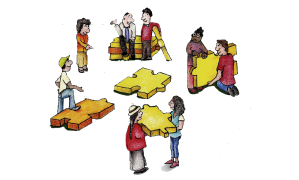 One of the main characteristics of participatory evaluation is that of forming evaluation teams which give local stakeholders the leading role.