Dear EvalParticipativa friends and colleagues, we hope this post finds you all well!
A few days ago, we symbolically crossed over the big pond to meet Héctor Núñez who lives and works in Barcelona. Héctor has worked exclusively on themes related to Participatory Evaluation (EP) for a long time. In this post, we would like to share his professional profile with you as well as some of his academic work. We are convinced it will enrich the training and reflection that we have been doing around these topics in our community of practice and learning.

Héctor Núñez qualified as a social educator at the University of Santiago de Compostela. He is a pedagogue and holds a PhD in Education from the Autonomous University of Barcelona. His professional experience mainly centres on social pedagogy, non-government organisations and the public sector. Héctor has participated in different research and consultancy projects in Spain and beyond. He is currently professor in the Serra Húnter programme in the Department of the Theory and History of Education at the University of Barcelona.
The main reason we contacted Héctor was to learn about participatory evaluation processes in community initiatives. As we talked, Héctor told us that the working perspective is wider with regard to evaluation. It views the role of Participatory Evaluation as part of the social pedagogy discipline and as a professional strategy within social education. We realised that there were large crossovers between what he told us and the issues that arose in our debates on the ‘whats’ and ‘whys’ of PE in our Gathering in Ecuador (2019).
 Dear friends, we are continuing to learn from each other and this time we will hear some thoughts from Fernanda Arriaza, TECHO member. This organisation works in 19 Latin American countries and seeks to overcome the poverty experienced by millions of people living in informal settlements through initiatives which unite the efforts of settlement dwellers and young volunteers. In this post, you can read about the lessons they learnt in an experience that was recently documented as part of an initiative in and with the Working Group.
 Going beyond the formal monitoring proposals (such as creating transparency and accountability), the participatory monitoring focus that we have developed at ONG – IDEAs includes our proposal to generate processes that empower and provide moments of learning for all those involved, focusing on the perspectives, self evaluation and commitment of target groups.
 As a result of the
 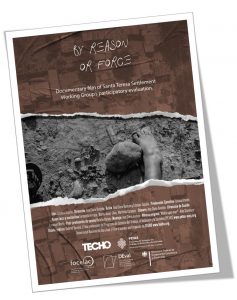 We would like to invite you all to participate in the official launch of our documentary By Reason or By Force and its accompanying round table discussion which will be held on 24 July at 6pm UCT -3 (see the trailer and link to participate at the end of this entry).
 Dear colleagues and friends, it is our great pleasure to begin the second half of this year by announcing this new pursuit and inviting you all to be a part of it.
 One of EvalParticipativa’s main aims is to share evaluation experiences that have not been shared before and learn from them. Another aim is to make public stories of lived experiences, struggle and social organisation which often go unnoticed by society even though they exist right under its nose. It is our great pleasure to share this documentary “By reason or by force”, an initiative which fulfils both these objectives.