by Andrea Meneses
 This tool was designed at the end of the participatory evaluation of the Cancer Prevention and Care Services in Valle de la Estrella, in the Limón province, Costa Rica, carried out in 2016 and 2017.
Click on the following links to watch videos that provide more information on this evaluation: video 1 and video 2. You can also access the full evaluation experience here.
AIM
The tool was developed to aid reflection on a completed evaluation experience including the lessons learned, difficulties and challenges faced and potential uses of the findings. This retrospective approach is intended to generate relevant reflections for those who wish to carry out similar processes.
Other games to encourage thinking were used during the evaluation, such as the ‘Myths and Beliefs about Cancer’ game. These thought-provoking games create conditions that encourage communication and the expression of feelings, experiences, information, ideas and expectations, as well as learning and acquiring new knowledge about different topics and situations in a horizontal manner (Tapella et al, 2022). If you want to know more about games that encourage thinking, we recommend you read this post.
The game cards feature questions that are based on the eight guiding principles of collaborative approaches to evaluation developed by Cousins et al (2015). Such approaches seek to conduct evaluations in partnership with the people targeted by the interventions, placing their interests and information needs, as well as the context, at the centre of the whole process.
These principles are: (1) explain the motivation to collaborate, (2) foster meaningful relationships, (3) develop a shared understanding of the intervention, (4) promote appropriate participatory processes, (5) monitor and react appropriately to resource availability, (6) monitor the development and quality of the evaluation, (7) foster evaluative thinking, and (8) provide follow-up to analyse usefulness.
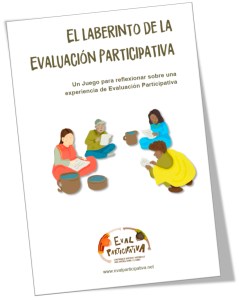 The Participatory Evaluation Maze adapts the indicators of each principle to create questions that enable evaluation, reflection and dialogue concerning the developments, difficulties and lessons learned during the participatory evaluation process. It also explores any challenges that arose during the process .
The tool, methodology and results obtained from using the Participatory Evaluation Maze game in the participatory evaluation of Cancer Prevention and Care Services in Valle de la Estrella, Costa Rica, are explained in detail by their authors in Sanz, Tapella and Meneses (2019).
GAME FORMAT AND MATERIALS
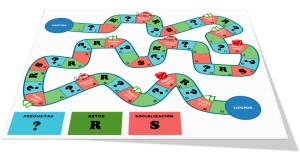 The game comes in folder that opens into a board.
The board consists of a maze which participants take turns to move along, responding to questions or challenges along the way.
There is also an instruction manual which explains the aim of the game, the materials required and the rules.
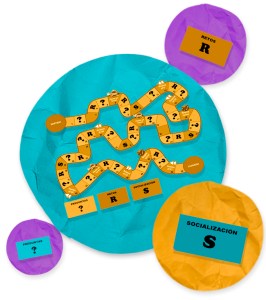
 There are three different coloured cards, which refer to QUESTIONS (as well as statements and slogans) designed to prompt a group discussion in which every participant can speak; CHALLENGES that arise during this type of evaluation; and SHARING activities for the group to promote a cordial and pleasant working atmosphere.
The game requires a dice and a counter for each participant.
You can download the game (in Spanish) from the following links:
- Folder and board
Instructions
Cards with QUESTIONS (sheet 1 and sheet 2)
Cards with CHALLENGES
Cards for SOCIALISATION
RECOMMENDATIONS
Although the tool we share in this post has a generic format that can be used in different processes, as with any game to encourage thinking, it should be reviewed and adapted to ensure that the content and vocabulary used are appropriate to the specific context and situation in which the participatory evaluation is to be implemented.
It is important to highlight the role of the facilitator, who takes notes on the discussions produced during the game. This person seeks to ensure that the group reaches consensual conclusions on each topic; if this is not possible, it is important to record any points of divergence. At the end of the game, it is advisable to summarise what has been discussed and, wherever possible, present the conclusions and general reflections on flipcharts.
As this exercise aims to provide an evaluative overview of what has taken place, it is important to stress the importance of respecting different opinions and guaranteeing the anonymity of reflections outside the group, while always striving for horizontal and respectful participation.
The following video describes the tool and the ways it can be used to promote a critical examination of participatory evaluations that have already been carried out.
References
Sanz, J. C., Tapella, A. Meneses (2019) Participatory Evaluation of Cancer Prevention and Care Services. A Case Study from Valle de la Estrella, Costa Rica, in Cousins, J. Bradley (ed), Collaborative Approaches to Evaluation: Principles in Use, Chapter II, pp. 47-53, CA: Thousand Oaks – SAGE Publications.
Tapella, E., P. Rodriguez Bilella, J. C. Sanz, J. Chavez Tafur, J. Espinosa Fajardo (2022) Sowing & Harvesting. Participatory Evaluation Handbook. DEval, Bonn, Germany