PETAS Working Papers are short publications designed to disseminate progress reports, interim findings and final results from research, studies and projects undertaken by the Programme, in this case, those linked to EvalParticipativa. Their purpose is to share technical and conceptual analyses on topics such as evaluation, social participation, social inclusion, public administration, public policy and development, thereby contributing to debate and reflection across Latin America and the Caribbean. They may cover case studies, methodological developments, research findings or public policy proposals, and are characterised by combining academic and technical rigour with accessible language for researchers, public officials, practitioners and students.
These publications are issued in digital format and are freely available through the PETAS and EvalParticipativa websites. They are conceived as a means of sharing knowledge as it develops, and their contents may therefore be reviewed, expanded or updated at a later stage. For identification and academic referencing purposes, they should be cited as PETAS Working Papers for EvalParticipativa, indicating the author’s name, title, document number and year of publication.
 STAKEHOLDER MAPPING: A TOOL FOR PARTICIPATORY EVALUATION
A Participatory Evaluation (PE) is one in which the parties involved in an intervention determine what will be evaluated, for what purposes, when it will take place, which data collection and analysis methods will be used, and how the findings will be communicated. PE seeks to ensure the active and conscious involvement of the so-called key social actors connected with the intervention. But who are these key social actors? How can we understand the relationships between them, and between each of them and the programme or project? This document (only in Spanish) seeks to address these questions by introducing the Key Stakeholder Mapping (KSM) technique, a tool for evaluations that aim to foster participation and social inclusion.
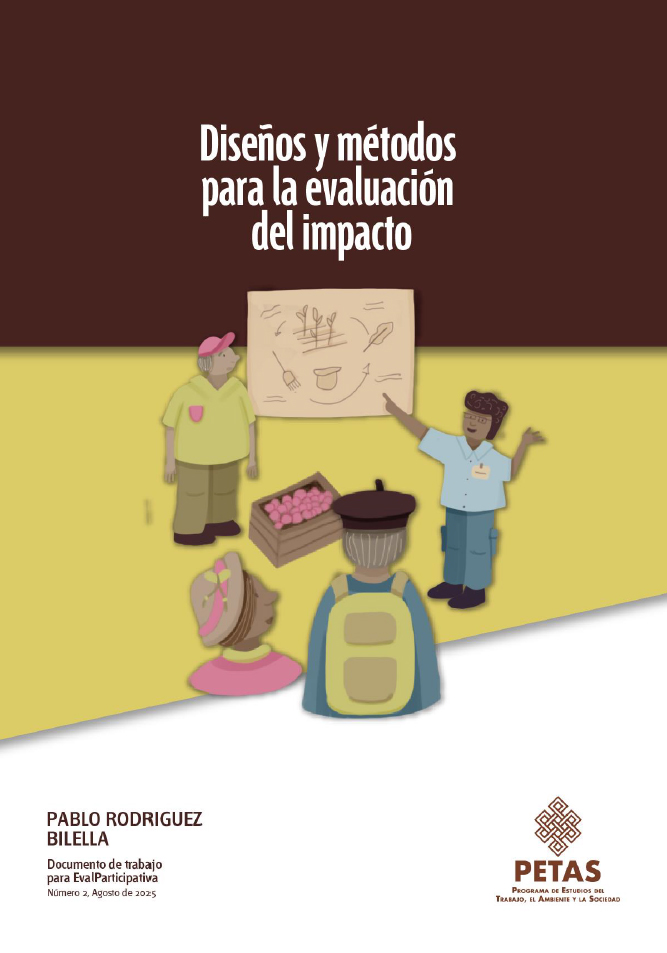 DESIGNS AND METHODS FOR IMPACT EVALUATION
This guide (only in Spanish) provides a conceptual and methodological overview of the impact evaluation of development programmes and projects. It presents the main debates surrounding causal attribution, the use of counterfactuals and standards of rigour in the production of evidence. It examines key aspects of designing relevant evaluations, from making values explicit and developing theories of change to measuring impacts, identifying explanatory factors, synthesising evidence and making use of evaluation findings. Finally, it describes various evaluation design approaches, highlighting methodological pluralism and the importance of adapting methods to each specific context.