Relationships and connections between Participatory Evaluation and Popular Education, Participatory Action Research, the Systematisation of Experiences and Collaborative Evaluation
by Valdo Nicolas Cerpa Ubilla
 Participatory Evaluation (PE) has become established as a way of addressing challenges in the fields of education and community development in Latin America and the Caribbean. Our region is well known for its cultural diversity, wealth of traditions, and the challenges to community development posed by its high rates of poverty. In this context, PE is a beacon of hope that illuminates a more inclusive and participatory path.
The first aim of this text is to examine and reflect on the nature of PE and the ways it relates to Popular Education, Participatory Action Research (PAR), and the Systematisation of Experiences. The second aim is to contrast PE with Collaborative Evaluation. It is hoped that this reflection will catalyse the transformational potential of PE and its role in building fairer, more participatory societies in Latin America and the Caribbean.
PE is not just another evaluation methodology. Rather, it is a philosophy, deeply rooted in participation, social justice and community transformation. In a setting where, historically, voices from the community have been marginalised and silenced, PE has emerged as a space of empowerment and recognition, inviting each individual to play the central role in their own story. Thus, we are enthusiastically reminded that if we want to bring about real change, we have to start from the grassroots, from our own experiences and knowledge.
Participatory Evaluation and how it relates to other methodologies
The links between PE and Popular Education, PAR and the Systematisation of Experiences is more than coincidental; they form an invisible web that connects our practices and knowledge in Latin America and the Caribbean. When reflecting on these ties, I am referring to more than merely intellectual concepts: we are discussing ways of understanding and transforming our realities.
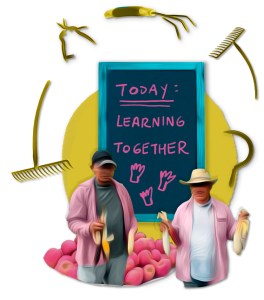 Ana Maria Araújo Freire (2018) reminds us of the importance of active community participation in knowledge construction. This idea is echoed by PE, in which community participation not only enriches evaluation but also empowers our communities. It is as though each voice and each experience acts as a supporting pillar in the construction of collective knowledge that, in turn, strengthens us as a society.
Paulo Freire (2018) invites us to reflect on a Pedagogy of Liberation, which arises from the collaboration and critical participation of all. This vision aligns perfectly with the premise of PE, which views community participation as an essential tool for empowerment and for enhancing the evaluation process. Thus, the active participation of each individual energises our collective pursuit of knowledge and transformation.
Raúl Zorrilla (2021) demonstrates the natural affinity between PE and PAR through their shared collaborative research and transformational action. Collaboration between evaluators and participants drives a dynamic and continual process of action and research, in which each step brings us a little closer to the transformation of the realities in which we are all immersed.
The emphasis on critical reflection in the systematisation of experiences approach harmonises with the focus of PE. By incorporating this systemic approach, PE goes beyond quantifiable results and delves into the richness of our processes and the lessons we have learnt. Each experience serves as an important piece in the jigsaw puzzle of our collective understanding and community action.
Thus, PE invites us to look beyond the simple act of evaluation in order to recognise the intrinsic value of community participation, critical reflection and collaboration as we seek the transformation of the realities we inhabit. It is a reminder that, together, we have the power to transform our communities and build a fairer, more equal world for all.
Similarities and differences between collaborative evaluation and participatory evaluation
In exploring the similarities and differences between Collaborative Evaluation and PE, we find ourselves before a complex, yet enlightening, landscape which has direct impacts on our practices and approaches in Latin America and the Caribbean. This approach is akin to looking into a mirror that reflects our different perspectives on evaluation and social change.
Both approaches value active participation highly. For Michael Patton (2018), Collaborative Evaluation involves collaboration between evaluators and stakeholders, while Santiago De Los Heros (2019) suggests that participatory evaluation stresses community participation at all stages of the evaluation process. Both appear to recognise the importance of listening to the voices of the people affected by the evaluation, thereby ensuring that the results are relevant and appropriate.
However, differences surface when we examine the way that power is distributed in each approach. Michael Patton (2018) emphasises the way that in collaborative evaluation, the ultimate responsibility remains with the evaluator. This may imply a more hierarchical structure. Conversely, Santiago De Los Heros (2019) stresses that a radical transfer of power to the community is key in participatory evaluation. This philosophical distinction affects more than just decision making; it also impacts levels of monitoring during the evaluation process.
Another significant difference concerns the focus on social change. According to Luisa Fernanda Gutiérrez (2022), PE has an explicit focus on social transformation, using evaluation as a tool for community empowerment and as a way of addressing systemic issues. By contrast, Patton explains how collaborative evaluation is more directed toward improving specific policies and programmes, and is not as focused on structural changes. This philosophical distinction affects more than just the different objectives for change; it also influences the strategic approaches used to achieve them.
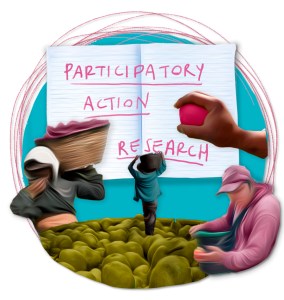 A reflection on these similarities and differences makes it clear that there is complexity and richness behind these two evaluation approaches. They both contribute unique and valuable perspectives on the best way to address the challenges that exist in our region. For each evaluation, we have to choose the approach that best adapts to our requirements and aspirations for change.
Both collaborative evaluation and PE invite us to reflect on power, participation and social change in our communities. When we use these powerful tools in a conscious and engaged manner, they can open the doors to a fairer, more equal and participatory future for everybody in Latin America and the Caribbean.
Conclusion
The profound connection PE enjoys with Popular Education, PAR and the Systematisation of Experiences enriches and provides context to its application in Latin America. Combined with these other disciplines, PE is revealed as a versatile tool that transcends the limitations of conventional evaluation.
It becomes a bridge to the active and conscious participation of our communities, a way of empowering people that historically have been marginalised or ignored in decision-making processes. It is as if PE reminds us to remember that true transformation begins with the voices and experiences of those individuals who experience this reality on a daily basis.
This reflection provides a comprehensive overview of the intersections between PE and other related methodologies and explores the complexities that emerge in the process. It provides a more robust framework for understanding and applying PE in Latin American contexts, one that is underscored by the conceptual framework of Paulo Freire.
When combined with other methodologies such as popular education, PE increases in versatility and depth, advancing beyond the frontiers of conventional evaluation. This is a reminder that evaluation is about more than just measuring results. Rather, it involves developing understanding and valuing the processes and lessons that emerge along the way.
It is not far-fetched to equate this discussion with a debate on the kind of power we want to participate in and how we want to build our collective future. This is a reminder that evaluation is not only a matter of measuring results but of understanding and valuing the processes and lessons that emerge along the way.
Ultimately, PE is not just another evaluation method; it is a philosophy that is deeply rooted in participation, social justice and community transformation. By recognising and embracing its conceptual wealth, Latin America can take full advantage of its potential as a catalyst of positive and sustainable change at all levels of society. This engagement not only drives continual improvement, but also empowers communities and enables them to be more autonomous, thus consolidating PE as a key pillar in the construction of fairer and more participatory societies.

References
Freire, A. M. A. (2018). Educação popular: um campo de múltiplos olhares. CRV.
Freire, P. (2018). Pedagogia do Oprimido. Paz e Terra.
Zorrilla, R. (2021). Investigación-Acción-Participativa: Tendencias Actuales y Retos Futuros. Tirant lo Blanch.
Patton, M. Q. (2018). Evaluación centrada en la utilización. Publicaciones SAGE.
De los Heros, S. (2019). Evaluación Participativa: Herramientas para la Gestión del Desarrollo Local. Ediciones Morata.
Gutiérrez, L. F. (2022). Transformación Social y Evaluación Participativa: Perspectivas y Desafíos. Siglo XXI.