by Dagmar Schumann
 The idea for the document shared in this post was first discussed during a conference on monitoring in Germany. Our objective was to identify literature on broadly applicable quality standards or criteria for monitoring that could be considered nearly universal in their validity and application. While such documents exist for evaluation and research, no comparable paper could be found for monitoring.
A team of experienced German consultants specialising in planning, monitoring, and evaluation undertook the task of carefully examining this knowledge gap and developing a detailed document in response. We started by asking ourselves what ‘effective’ monitoring looks like. The first step was to conduct an extensive literature review. Subsequently, we developed the document ‘Quality Criteria for Monitoring in Development Cooperation‘ based on a thorough qualitative analysis of all available information.
The group participated in an online collaboration process that spanned over two years, beginning in 2020 during the COVID-19 pandemic. This resulted in 10 quality criteria for good monitoring. The document below presents an abridged version in both English and Spanish, which highlights the key findings and insights from our research and learning.
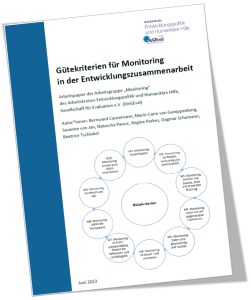 For those interested in learning more, the complete document is available in German. It provides a comprehensive comparative analysis of monitoring and evaluation concepts.
We are delighted with the outcomes of this collaborative effort. Drafting a document of this nature is challenging, but with patience, open dialogue, and a strong commitment, it can be achieved. We hope this document will resonate with professionals in the EvalParticipativa community of practice and learning, who will likely recognise the importance of its principles, particularly the first, which emphasizes the participatory nature of monitoring. In other words, monitoring should effectively involve all project stakeholders (especially the target groups) in the different phases of the intervention (planning, implementation and evaluation, interpretation and use of monitoring data).
As a final note, we invite you to explore our work. Below, you will find a list of authors, all of whom are consultants in international cooperation with extensive experience in outcomes and impacts, planning consultancy, monitoring, and evaluation.