The role of participatory evaluation in contexts of polarization in Latin America
by Leopoldo Font
 At a crucial moment for Uruguay (my country) and the region, reflection on the role of participatory evaluation takes on particular relevance. Despite their limitations, evaluation tools offer a unique opportunity to address current challenges in an effective and sustainable manner. On the one hand, these tools can contribute to reducing polarization, foster collaboration and promote more inclusive solutions; on the other hand, they require significant resources and face the risk of bias in their implementation.
This article, based on my publication in La Diaria, seeks to connect the central ideas developed in that text with the participatory and transformative perspective that characterizes the EvalParticipativa community of practice and learning. Thus, it explores how these tools can act as a catalyst to overcome divisions, build bridges between diverse sectors and promote a more just and equitable development.
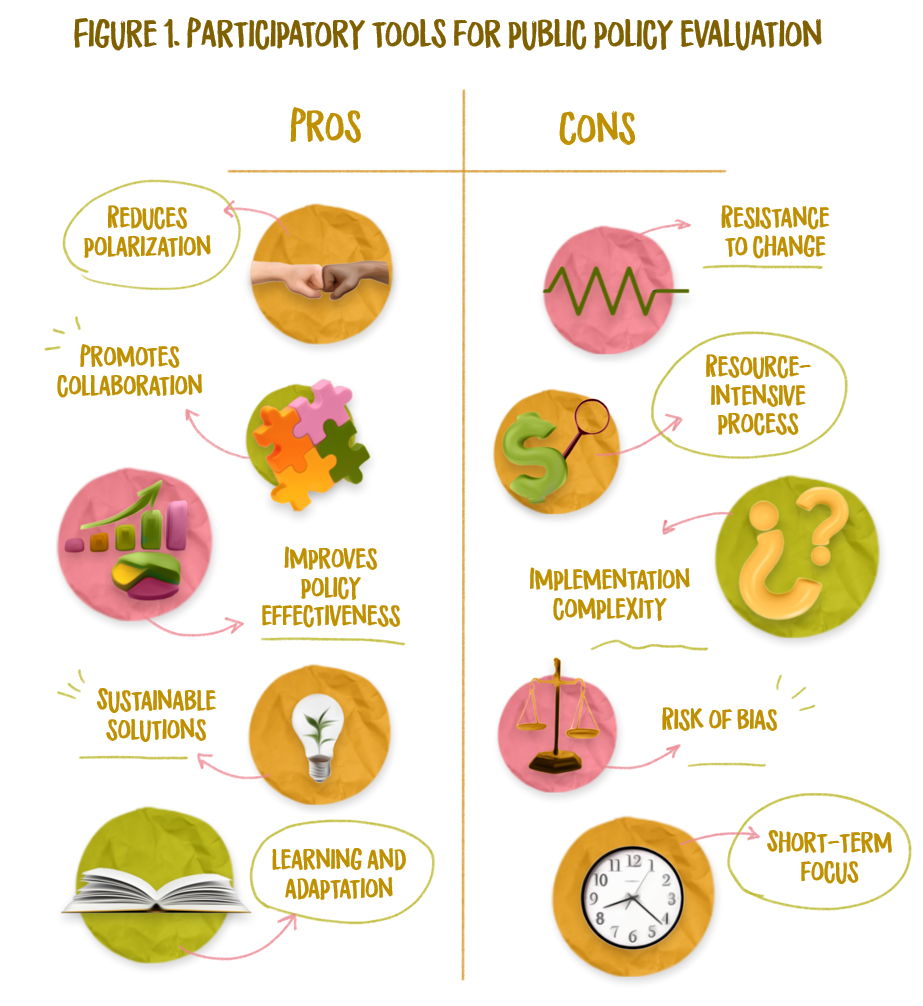
It is essential, at this point, to stop and analyze the balance of participatory tools, as illustrated in Figure 1. This figure presents a comparative diagram between the benefits and challenges involved in the implementation of this type of evaluation in the area of public policy. In polarized scenarios, such as those we face in Latin America, Figure 1 presents us with a series of advantages that highlight the transformative potential of participatory tools. The ability to reduce polarization by promoting dialogue and mutual understanding is presented as a central pillar. In addition, the image highlights how participatory assessment can encourage collaboration among diverse actors, creating spaces for the joint construction of solutions. It also highlights the potential of these tools to improve the effectiveness of policies by incorporating the experiences and knowledge of the people directly affected. How could we maximize these benefits in our Latin American contexts, characterized by political and social polarization?
However, as is also evident in Figure 1, we cannot ignore the challenges and constraints that, if not properly managed, could sabotage the potential of participatory evaluation. On the right side of the diagram, under the heading ‘cons’, we warn about the potential resistance to change that may arise among some stakeholders, the resource-intensive nature of these processes, the complexity of implementing participatory methodologies and the possibility of introducing a risk of bias in the conclusions. Additionally, the figure points to the propensity of some processes to have a short-term focus, which may limit their transformative potential. These challenges, represented visually in the image, invite us to reflect on how we can mitigate the risks and ensure that participatory processes are, far as possible, as effective as possible. What concrete strategies can we use to transform these challenges into opportunities for improvement? In summary, Figure 1 provides an overview of the opportunities and challenges we face in implementing participatory evaluations in our public policies.
On the other hand, it is worth mentioning that said article was written in October 2024, when Mexico’s National Council for the Evaluation of Social Development Policy (CONEVAL) still maintained a certain institutional stability. However, in November of the same year, the Mexican Senate approved a reform that officially dissolved CONEVAL, transferring its functions to the National Institute of Statistics and Geography (INEGI). This measure—framed as a reform to optimize resources and avoid duplication—has raised serious concerns, and I am among those who have spoken out in defense of the institution’s technical independence.
As a key reference for Latin America, the CONEVAL has demonstrated how evaluation can transform lives by improving public policies, while ensuring institutional stability and strengthening transparency and accountability, elements that are essential to maintain its credibility and effectiveness. The weakening of CONEVAL not only affects Mexico, but also sends a worrying signal to the region about the risks of integrating evaluation functions under governmental structures that may compromise its autonomy.
The Mexican experience highlights the risks associated with the loss of institutional autonomy in evaluation agencies and underlines the need to protect these fundamental capacities to guarantee independence, institutional stability, transparency and accountability, essential pillars in any robust evaluation system. In this sense, the CONEVAL case becomes a wake-up call for Latin America on the importance of preserving independence in evaluation processes, as shown in the following comparison in Figure 2.
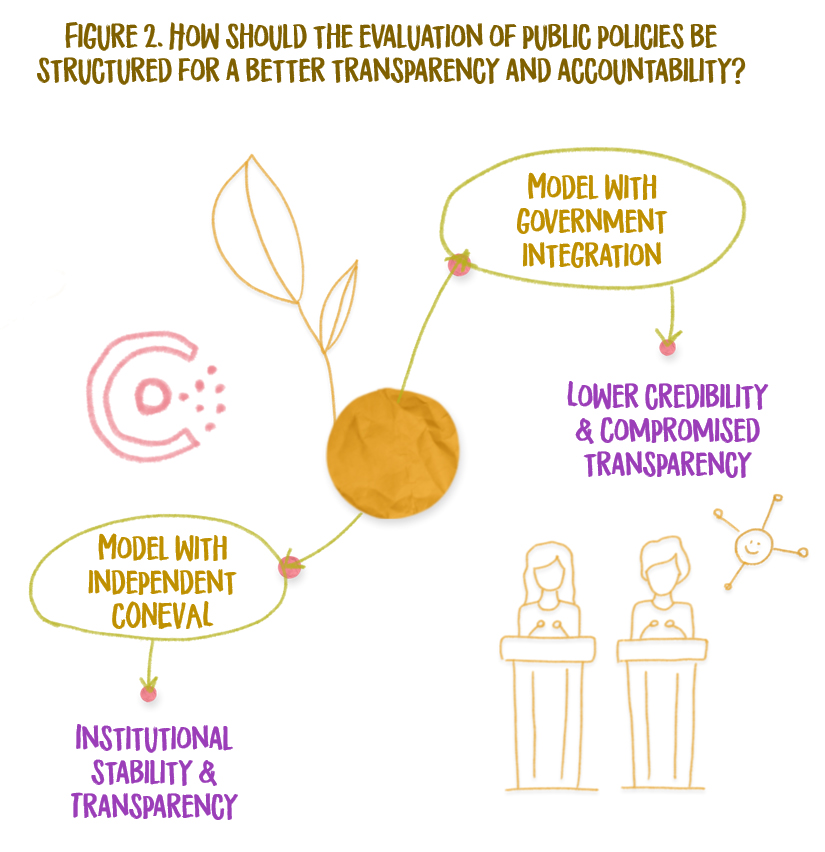
This figure contrast two potential structures for public policy evaluation: a model with an independent CONEVAL and another with government integration. The left side of the image highlights the strengths of an independent CONEVAL, indicating that this structure seems to facilitate institutional stability and transparency in the evaluation process. By having autonomy, an independent body is better positioned to analyze public policies with greater objectivity and without undue pressure. How does this autonomy influence the quality of the evaluation and the citizenry’s confidence in the results?
On the other hand, Figure 2 also presents a model with governmental integration, warning about the risk of compromising transparency and accountability. By subordinating the evaluation function to government structures, there is a risk that evaluations will be biased by political or partisan interests. How can we prevent public policy evaluation from becoming a tool to justify government actions instead of improving the quality of policies? Figure 2, in summary, illustrates visually the importance of safeguarding the autonomy of evaluation agencies to try to ensure transparent, credible and effective processes.
Evaluation in polarization contexts
Evaluation is far from being a merely technical exercise; it is inherently political and social in nature. In societies marked by polarization, such as many in our region, promoting a culture of evaluation implies a significant political challenge. Governments face barriers to admitting shortcomings in their policies, given the risk that these findings may be instrumentalized by political and media opponents to weaken their legitimacy. In this context, even those officials most committed to transparency may fear the political consequences of exposing results that reveal errors or inefficiencies.
Is it possible to encourage a culture of evaluation in these scenarios? Although the polarized context presents serious limitations, moving towards the creation of independent evaluation entities , with clear mandates of autonomy and transparency, can be a fundamental tool to generate confidence in the evaluation processes. However, these entities should not be seen as a sufficient solution, but as part of a broader approach that promotes spaces for constructive dialogue and shared learning among all sectors of society.
Facilitating common ground and promoting an honest dialogue on the strengths and weaknesses of public policies are necessary steps to overcome polarized dynamics. This approach is echoed in the principles of participatory evaluation, where communities and other key stakeholders are not only subjects of policies, but also protagonists of their analysis and improvement. In this sense, rather than seeking to eliminate political tensions, it is a matter of building capacities to manage disagreement and promote an evaluation that is not seen as a tool for attack, but as an opportunity for collective improvement.
The dynamics that evaluation adopts in polarized contexts are diverse and complex, as shown in Figure 3. The upper left quadrant shows a scenario of constructive dialogue in public management, where there is high participation but low transparency. How can we foster spaces for constructive dialogue in which the participation of various actors is active and genuine?
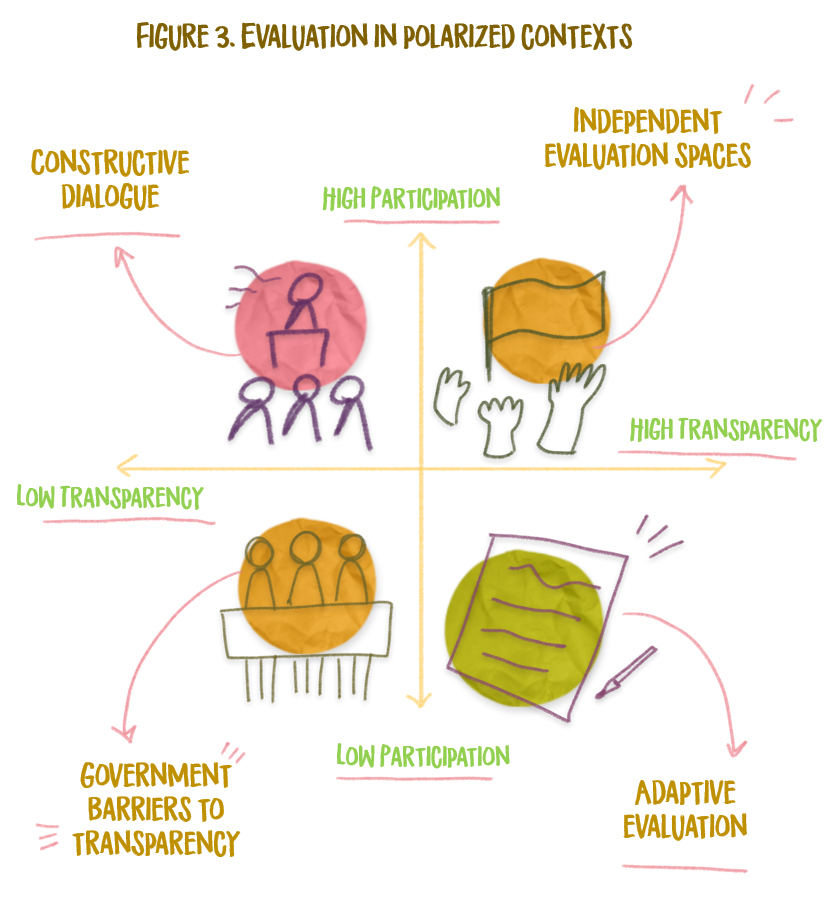 In the upper right quadrant, we find independent spaces for evaluation, where high participation and high transparency are combined. In this case, greater control over evaluation biases is achieved and a higher level of confidence in the results is promoted. Why is it essential to have independent spaces for evaluation in contexts of polarization?
The lower left quadrant shows a scenario of governmental barriers to transparency, where both participation and transparency are low. This situation is worrisome as it prevents a critical analysis of public policies and limits the possibility of translating evaluation results into concrete improvements. How can we overcome the barriers to transparent and participatory evaluation
Finally, in the lower right quadrant, a scenario of adaptive evaluation initiatives is presented, where an attempt is made to maintain a balance between low participation and high transparency. Although it does not achieve optimal participation, this type of initiative demonstrates the possibility of adapting to adverse contexts. What adaptive evaluation strategies can we implement when participation is not possible or is limited? In summary, Figure 3 invites us to analyze the various evaluation scenarios in polarized contexts, and challenges us to transform those dynamics that limit the effectiveness of evaluations
Democratic quality as a horizon
A strong democracy requires not only transparent and accountable institutions, but also processes that allow citizens to know, participate and demand accountability. From EvalParticipativa’s perspective, this aspect is crucial: although participatory evaluation represents a step towards the democratization of institutions, it is important to recognize its limitations in contexts where democracies are still fragile.
The case of San Francisco Huilango, in Tochimilco, Puebla (Mexico) , illustrates the potential and challenges of this approach. There, a community water management model, based on Integrated Water Resources Management (IWRM), promoted the active participation of the inhabitants in decision-making related to water supply and quality. This process made it possible to identify and solve local problems with a participatory perspective. However, it also highlighted the need to strengthen the management capacities of rural communities and to ensure their political and institutional recognition in order to consolidate these advances (Tomé Hernández and Villarreal Manzo, 2023).
In this sense, participatory evaluation should not be seen as a single or immediate solution to the challenges of democratic quality, but as an essential component within a broader effort to empower communities and strengthen democratic processes. This approach has the potential to deepen democracy by involving people in the processes of decision-making, reflection and improvement, but it requires political commitment and institutional support to generate a sustainable and significant impact.
Figure 4 presents us with a visual metaphor for the path to a strong democracy through the strengthening of community management. In this image, we see a bridge spanning a void, connecting two banks. On the left bank, we find fragile democratic processes, while on the right bank we see empowered communities with a strong democracy. This void represents the challenges we must overcome to achieve a stronger and more participatory democracy. The central text of the image, “Implementing a participatory water management model”, tells us that community water management can be a path to empowered communities and stronger democracy. How can we adapt participatory models like the one in San Francisco Huilango to apply in other contexts?
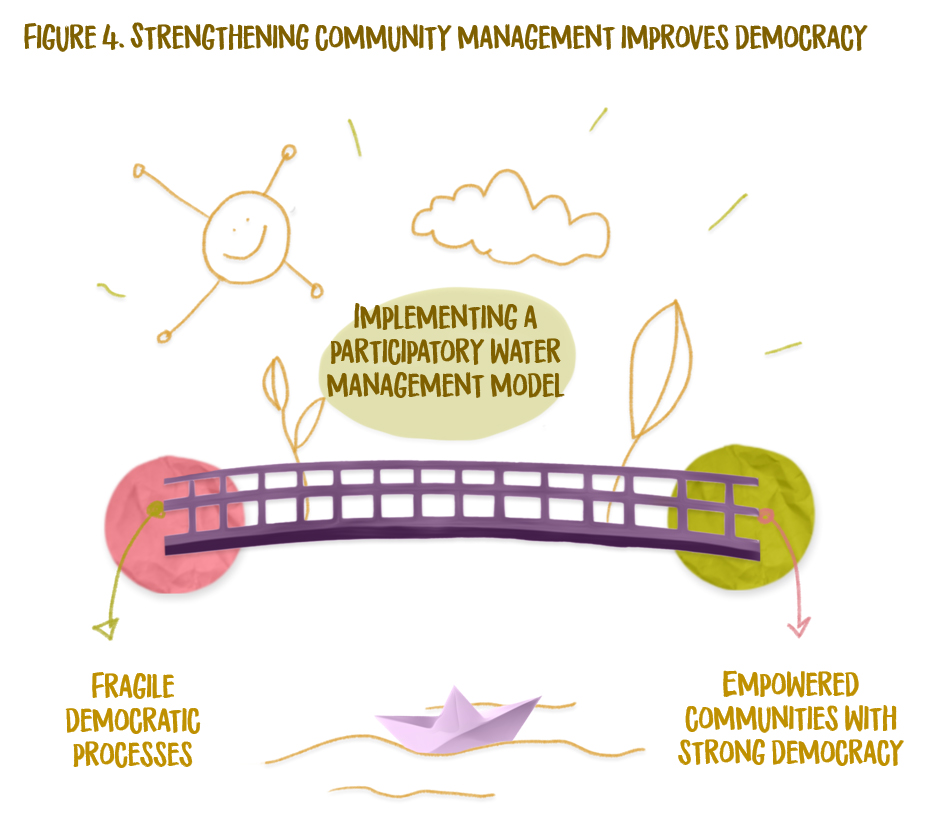
Figure 4 invites us to reflect on how participatory processes can act as a bridge to overcome obstacles and strengthen grassroots democracy. “However, this approach faces significant challenges, as illustrated by the case of San Francisco Huilango. It is necessary to strengthen the management capacities of the communities and guarantee their political and institutional recognition so that these processes are substantively sustainable and generate a positive impact on democratic quality. In summary, Figure 4 shows how community management and citizen participation can be fundamental to building a stronger democracy and empowering communities.
Sustainability as a cross-cutting approach
It is necessary to align public policies with the Sustainable Development Goals (SDGs), recognizing the interdependence of economic, social and environmental challenges. In this sense, evaluation not only measures results, but also allows us to reflect on the relevance, effectiveness, efficiency and equity of public interventions.
From the perspective of participatory evaluation, this reflection is enriched by including the voices of the communities affected by the policies, promoting joint learning towards fairer and more sustainable development. Community inclusion is key to aligning policies with the SDGs and preventing them from reproducing patterns of exclusion or inequality.
However, not all public policy initiatives manage to balance these elements. While projects such as SDG-aligned renewable energy with high community inclusion may reflect an ideal model, others, such as conventional infrastructure with low community participation, highlight the risks of advancing sustainability without considering social dynamics. In this framework, the assessment not only informs, but also guides the transition towards more inclusive and sustainable practices, allowing the course of policies to be adjusted to maximize their positive impact.
Figure 5 presents a graphic representation of how different types of public policy initiatives relate to sustainability, taking into account two factors: alignment with the SDGs and community inclusion. As illustrated in this figure, we can observe a cycle that shows us how these initiatives complement or oppose each other. In the upper left, we see a social development initiative that, while promoting community inclusion, shows low alignment with the SDGs. How can we ensure that social development initiatives are aligned with sustainability goals?
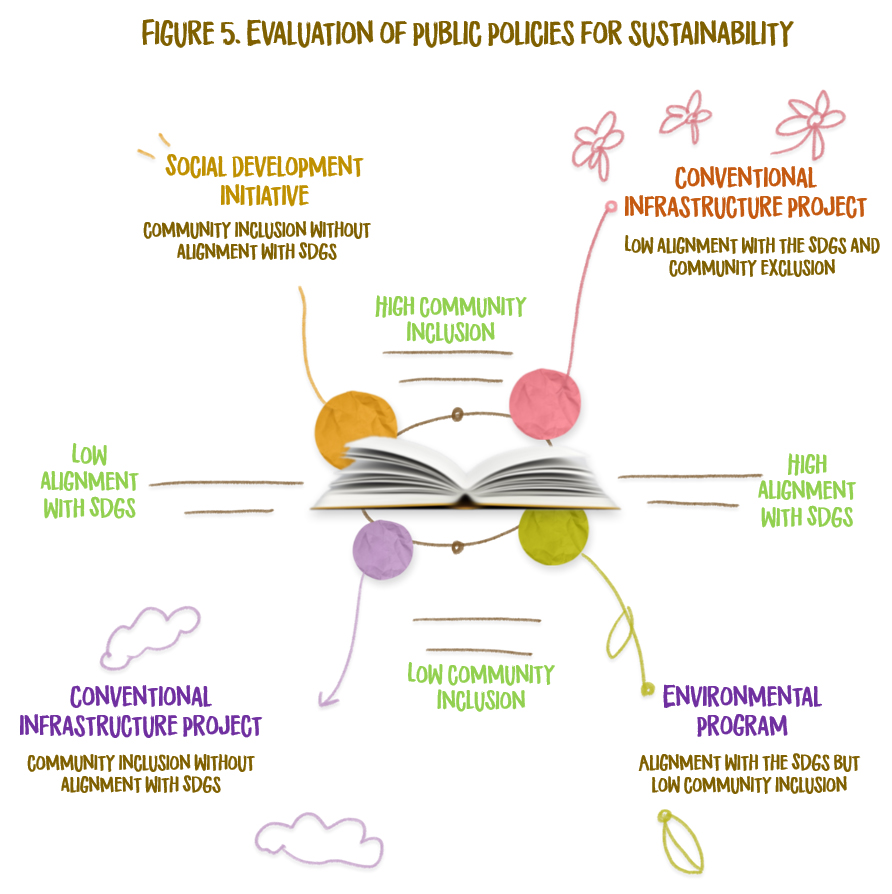
At the top right is a renewable energy project, which achieves high alignment with the SDGs and high community inclusion. This project reflects an ideal model in which sustainability is achieved through initiatives that promote both social inclusion and environmental protection. What characteristics of renewable energy projects can serve as a model for other initiatives?
On the lower left, we can see a conventional infrastructure project, which has a low alignment with the SDGs and community exclusion. These types of projects, while they may generate short-term economic benefits, do not contribute to long-term sustainable development. How can we avoid the proliferation of infrastructure projects that do not consider sustainability?
Finally, on the lower right, an environmental program is presented that, although it shows alignment with the SDGs, it has low community inclusion. This scenario highlights the importance of not only achieving environmental goals, but also promoting the participation and empowerment of communities in this process. How can we achieve environmental programs that actively involve communities? In summary, Figure 5 invites us to reflect on the complexity of sustainability and how participatory assessment can help us move towards fairer and more equitable policies.
Towards a transformative approach
Ultimately, both my original article and the principles of EvalParticipativa agree on the importance of viewing evaluation as a transformative tool. This implies going beyond traditional indicators to consider the real impact on the lives of people and communities. Evaluation should be a driver of change that not only reports on what works or does not work, but also contributes to designing more inclusive, sustainable and long-term oriented policies.
Likewise, strengthening local capacities and building an evaluation culture that transcends political cycles and ideological tensions are essential steps to guarantee its relevance and sustainability. This includes protecting evaluation institutions from the risks they face, as demonstrated by the case of CONEVAL in Mexico, where the loss of institutional autonomy has raised alarms throughout the region. Protecting these key capacities not only aims to ensure transparency and accountability, but also to strengthen the credibility and effectiveness of public policies.
Participatory evaluation, by involving communities in the processes of reflection and improvement, offers a transformative approach that transcends the limits of traditional measurement. In doing so, it allows the people affected by policies to be protagonists in their analysis and design, fostering a more robust democracy and more equitable development.
To make evaluation substantively a transformative tool, it is necessary to broaden its scope and consider several key elements, as summarized in Figure 6. In this figure, we see a pyramid that represents “Evaluation as a transformative tool”, from which four lines emerge that point to the pillars for achieving this approach. The top line highlights the importance of going beyond traditional indicators. How can we measure the substantive impact of public policies on the lives of people and communities, beyond quantitative data?
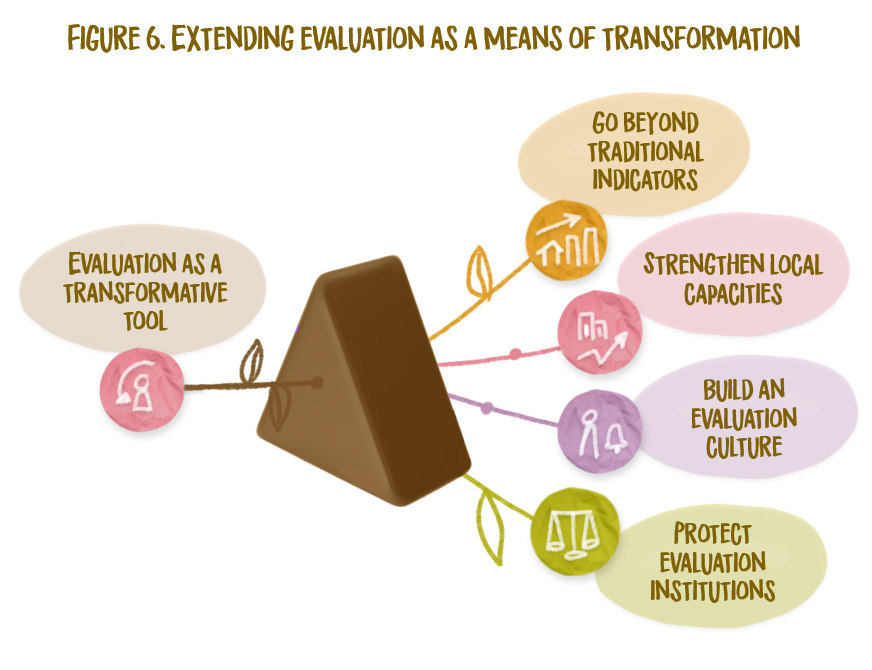
The second line highlights the strengthening of local capacities. For evaluation to be sustainable and generate lasting change, it is essential to strengthen the capacity of communities to actively participate in the evaluation and management of public policies. What strategies can we implement to strengthen these local capacities?
The third line mentions the construction of a culture of evaluation. Evaluation should not be seen as an isolated event, but as part of a continuous process of learning and improvement. How can we foster a culture of evaluation that transcends political cycles and ideological divides?
Finally, in the fourth line we highlight the protection of evaluation institutions. As we have seen with the case of CONEVAL, it is essential to protect the autonomy and independence of the institutions in charge of evaluation to guarantee their credibility and effectiveness. What measures can we take to protect these institutions from political pressures and the risks of instrumentalization? In summary, Figure 6 offers us a visual roadmap for scaling up evaluation as a transformative tool, highlighting the need to go beyond traditional indicators, strengthen local capacities, build a culture of evaluation and protect evaluative institutions.
An invitation to dialogue
As the author of this article, inspired by my original publication in La Diaria, I would like to invite people linked to the EvalParticipativa community of practice and learning to reflect and share their experiences on how participatory evaluation has contributed to improving sustainability and democratic quality in their contexts. This rethinking seeks to connect the challenges and learning highlighted in the article with the participatory approach that characterizes this community.
The debate on the role of participatory evaluation in Latin America, in a context marked by polarization, democratic challenges and environmental crises, is more relevant than ever. The ability to design and carry out evaluations that involve communities, respect their autonomy and contribute to inclusive policies is undoubtedly an urgent task. This article is intended as an open invitation for analysis and exchange of ideas for further progress on these issues. I hope that these reflections can add value to the collective (and constructive) dialogue that EvalParticipativa promotes and that they inspire new discussions on how to make participatory evaluation an even more transformative tool.
Finally, with Figure 7 we try to present in a synthetic way the impact that participatory evaluation seeks to generate. In this figure, we see four central elements that represent the main results we aspire to achieve through evaluation: improved sustainability, policy transformation, democratic quality and community impact. The image highlights that participatory evaluation is not an end in itself, but a means to achieve profound and positive changes in our societies. Looking at this figure, how can we leverage these four impacts holistically in our communities?
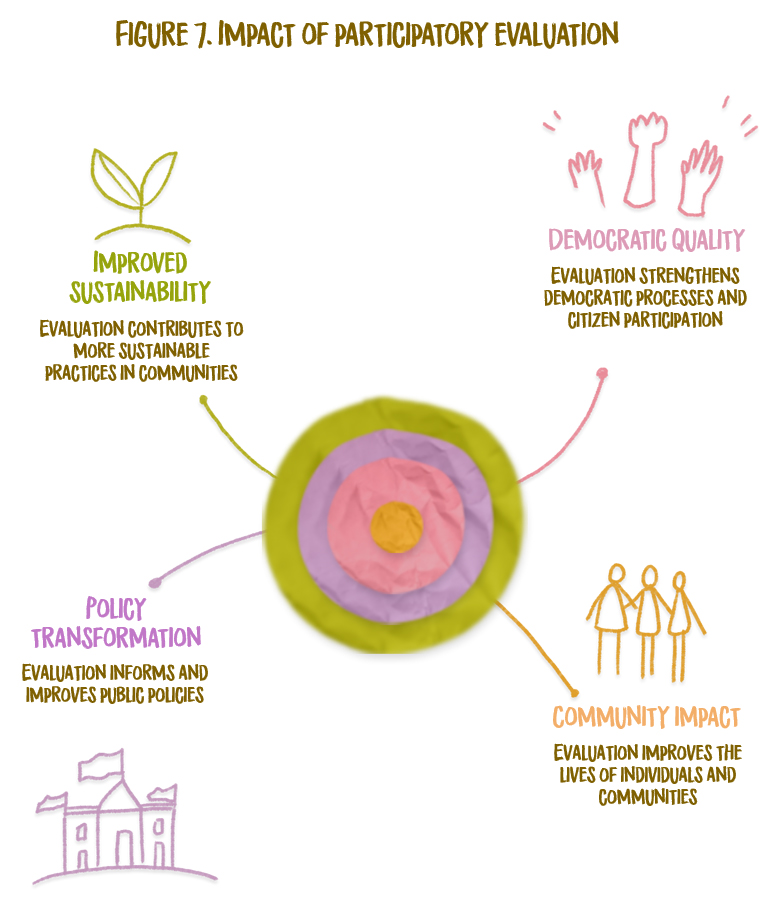
On the left side of the image, I highlight the improvement of sustainability and policy transformation. I understand that participatory evaluation seeks to generate more sustainable practices in communities and to transform public policies so that they are more effective and oriented to the common good. On the right side, I emphasize democratic quality and community impact. I believe that participatory evaluation not only seeks to strengthen democratic processes and citizen participation, but also to enhance the lives of people and communities, allowing evaluation to focus precisely on people and their needs. How can we use these elements to guide our work in participatory evaluation?
This Figure 7 synthesizes the main ideas we have explored throughout the article. It reminds us that participatory evaluation has a transformative potential that goes beyond measuring indicators; its ultimate goal is to improve people’s lives and strengthen our democracies. This image seeks to inspire us to continue working together in the search for public policies that are inclusive, sustainable and equitable. In this way, Figure 7 invites us to continue talking and learning in community, inspired by the transformative potential of participatory evaluation.