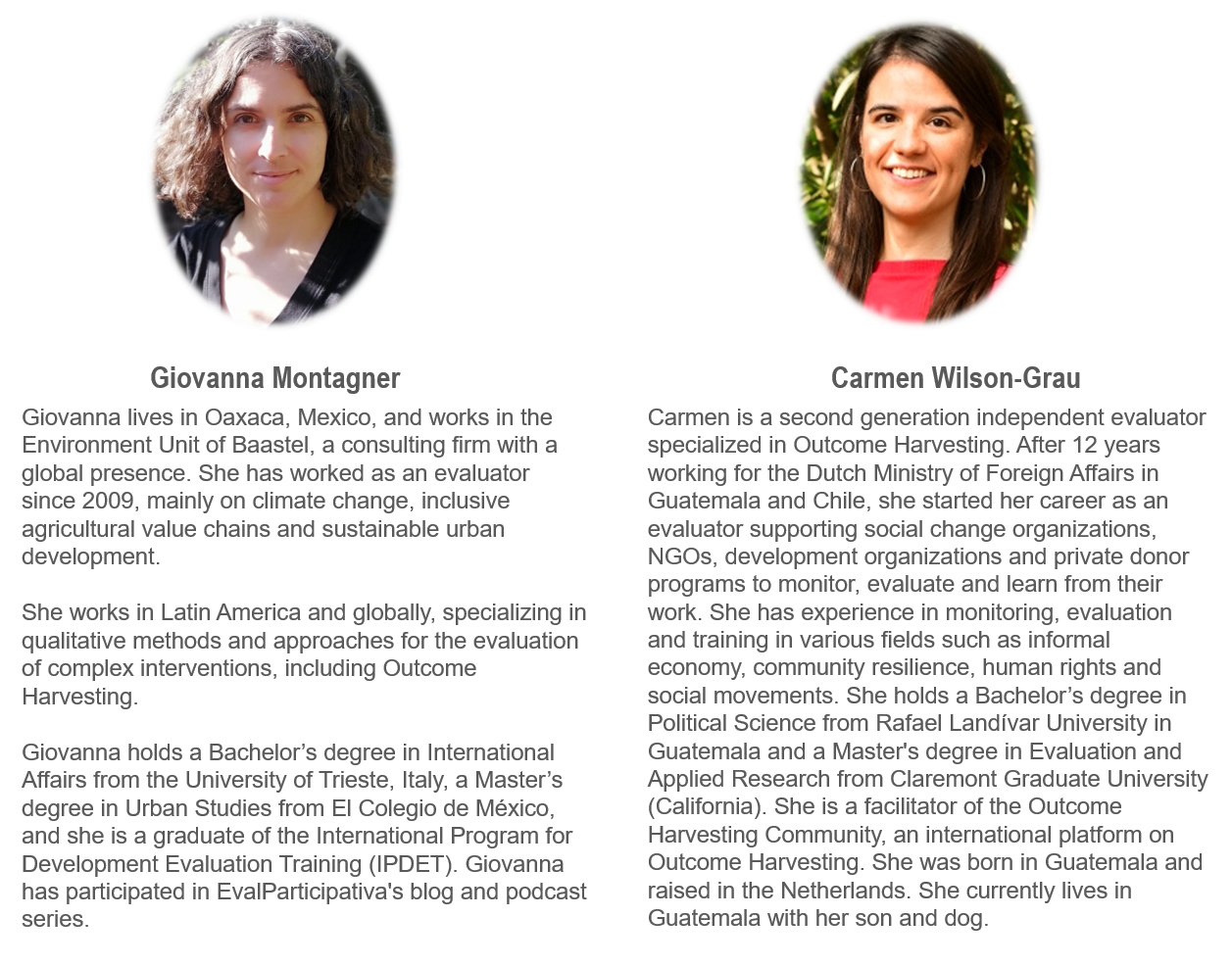
By Giovanna Montagner and Carmen Wilson-Grau
 Outcome Harvesting is a participatory method used to identify, formulate, analyze, and learn from the changes brought about by an intervention, especially when cause-effect relationships are complex or unknown.
Rather than focusing on predefined objectives, it looks at what has actually changed and how the program contributed to those changes. This method emphasizes utilization, enabling evaluators, donors, and project/program managers to identify, formulate, verify, and make sense of the outcomes of an intervention.
This method brought us together. We met in 2019, when Giovanna, after attending a training on Outcome Harvesting, contacted Carmen to practice with her. Since then, we’ve kept up the habit of having virtual coffee chats every now and then. Today, we’ve come together to talk about Carmen’s experience using Outcome Harvesting for monitoring.
Giovanna (G): How did you come across Outcome Harvesting and what drew you to it
Carmen (C): I’d say Outcome Harvesting came to me. My father, Ricardo Wilson-Grau, had been developing this method since 2002 and used to tell me about his progress during every family gathering. After living in Chile for three and a half years, I returned to Guatemala in 2015 and asked if we could work together so I could learn the method — and his eyes lit up! My first Outcome Harvesting was an evaluation of Save the Children Sweden’s Regional Program for Latin America and the Caribbean in 2016. What I loved most was the focus on working directly with people in a participatory manner — that human connection to understand the impact being made.
G: In a few words, what is Outcome Harvesting and what is it used for?
 C: Outcome Harvesting helps identify the behavior changes of social actors due to the influence of an intervention. It’s used to look beyond activities and evaluate their effect — that is, to determine what changes have occurred thanks to a project or program’s contribution, or which ones haven’t moved toward the broader goal of social change. Outcome Harvesting is especially suited for evaluating complex interventions, with high levels of uncertainty, focused on changing behavior — for example, advocacy or capacity-building projects. It is not suitable for evaluating interventions requiring quantitative measurement or that have a proven theory of change, such as vaccination or infrastructure programs.
G: How are you currently integrating Outcome Harvesting into your work?
C: I’m the Monitoring, Learning, and Evaluation Coordinator for a global network that works with organizations of informal economy workers, strengthening their capacity to advocate for better working conditions. I was brought onto the team to implement Outcome Harvesting as the main monitoring method, since they wanted to focus on measuring behavior changes rather than just activities.
It’s been a multi-year process. It started in 2018 with training for all staff directly involved in programs, since they’re responsible for harvesting outcomes for reports twice a year. I support the proper application of the method and lead the annual outcome analysis and interpretation, which includes learning sessions for each program and at the organizational level. These sessions focus on reviewing change processes and patterns emerging from the outcomes: which types of actors changed, what kinds of changes were observed, how the organization contributed, and how other actors contributed, among other insights.
We also compare outcomes with the organization’s five-year strategy and consider all unexpected and unintended changes. The idea is for this analysis to inform strategic planning for the following year.
G: Outcome Harvesting is often used as an evaluation method. How can it be adapted for monitoring?
 C: Based on my experience, the first difference is that when using Outcome Harvesting for monitoring, the people implementing the programs are the ones harvesting outcomes — not me. My role is to provide guidance and train new team members. That means harvesting is done by internal staff, not external evaluators.
Secondly, in our organization, where Outcome Harvesting is institutionalized as the main monitoring and evaluation method, we developed a template within our intranet system to streamline the harvesting process. When someone identifies an outcome, they can log into the intranet and fill out all the details either from a computer or directly from their phone — say, if they’re in the field or in a meeting. The idea is to document outcomes as soon as they’re identified. Outcomes can be exported in Excel format for analysis.
Thirdly, a key difference when using Outcome Harvesting for monitoring is that we don’t substantiate each outcome as it’s harvested, since the outcomes are used internally for learning and substantiating them every six months would require a lot of resources. After five years of implementation, we’re now considering substantiating some of these outcomes since we want to begin using them externally — for example, publishing them on the website or for fundraising.
G: How does Outcome Harvesting facilitate participatory monitoring?
C: Instead of saying we’re going to evaluate, I increasingly tell people we’re co-evaluating, because — as many evaluators know — evaluation can feel intimidating or tedious. Outcome Harvesting enables co-evaluation through its participatory nature. In monitoring, where the organization’s staff harvests outcomes, participation is implicit. That’s something I find very valuable because as people harvest, they learn. For instance, when they identify negative or unintended outcomes, they discuss them with their team to understand what happened and how to address it. Continuously harvesting outcomes also helps them get a general sense of how their work is progressing.
G: Are there spaces where, in addition to internal staff, partners or collaborators in the interventions are involved?
C: When we identify a chain of outcomes — a change process where one outcome leads to another — we develop an impact story that goes deeper into how the change process happened and who contributed. This involves interviews with collaborators or partner organizations. Sometimes, we also hold a learning discussion on the impact story and invite external actors to share their perspectives. However, since we use Outcome Harvesting primarily for internal learning, it’s not common to involve external actors. For the upcoming outcome substantiation, we’re thinking of other ways to engage these stakeholders.
G: What are the main lessons from applying Outcome Harvesting for participatory monitoring?
C: The first lesson is that people need time to learn. In my organization, it’s been a multi-year process. We’ve allowed time for staff to integrate Outcome Harvesting into their work and mindset. One-off training isn’t enough — we’ve provided ongoing support in introducing the method, applying it, and using the evidence from outcomes for learning. We’ve let it happen organically, incorporating Outcome Harvesting into existing learning processes.
The second lesson is to respond to emerging needs, for instance, developing the necessary tools and resources to help integrate Outcome Harvesting into the organization’s work. In our case, in addition to the intranet outcome template, we developed a toolkit and a monitoring, evaluation, and learning framework. This framework explains why we are a learning-focused organization, what learning means to us, what our learning questions are that help us reflect on and interpret outcome evidence, and the milestones, roles, responsibilities, and resources available for learning. The toolkit consists of a series of guides supporting the use of the method across its steps — from formulating an outcome to conducting an analysis and interpretation workshop. All are available online.
G: What challenges lie ahead for improving this even further?
C: We’ve begun supporting grassroots organizations we work with in strengthening their monitoring, evaluation, and learning systems, introducing Outcome Harvesting as an option and assisting with its adoption if they choose it. These grassroots organizations are affiliated with four global networks, so we work at the network level. We realized it’s more effective for someone within the global network or a regional coordinator — who are in regular contact with grassroots organizations — to be the one identifying and documenting outcomes. Leaders from these organizations have been involved, but their time is limited. There’s still work to be done to help them get the most from the method and find effective ways to gather the information needed to draft outcomes and learn from them.
 Internally, I would like to see outcomes used more regularly, beyond the annual learning discussions. Any program can download outcomes from the intranet system at any time to analyze and draw insights, but doing this more frequently and independently is still a challenge.
Another challenge has been how to follow up on the trainings we offer, which form one of our organization’s three strategic pillars, to see how participants apply their new knowledge and skills. We’re now exploring how to integrate Outcome Harvesting into training planning, which involves having a clear idea of what we want to evaluate before the workshop and conducting follow-up activities afterward to harvest outcomes and gather other information.
G: What would you recommend to those who want to apply Outcome Harvesting for monitoring?
C: Having a coach is key when starting to use Outcome Harvesting for monitoring — you need that methodological support from someone experienced in the method. You can either hire someone, like in my case, or train someone internally with temporary support from an external consultant. It’s also essential to identify champions — people who enjoy the methodology and grasp it quickly — and ask them to support their teams.
If you’d like to learn more about using Outcome Harvesting for monitoring, we suggest the following resources: