by Fidel Arévalo
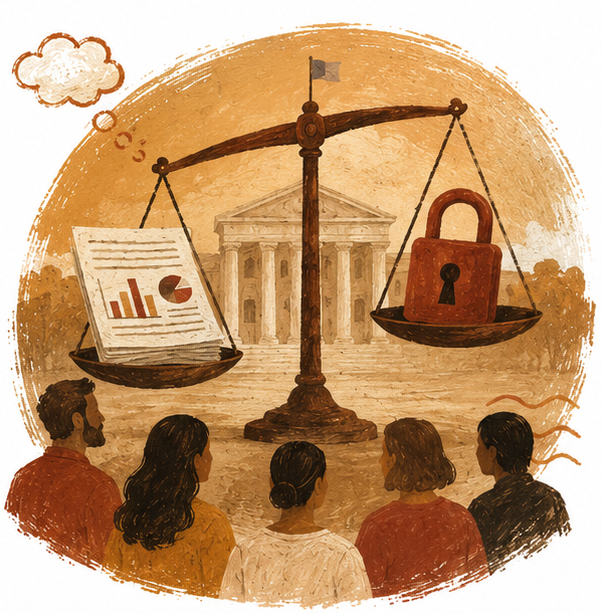 For many years, evaluation was underpinned by a powerful promise: to produce evidence on what works and what does not, in order to guide fairer, more efficient and more democratic public decisions. In this context, evaluation was not merely a technical tool, but a political instrument in the best sense of the term: a means of expanding freedom, strengthening accountability and bringing the exercise of power closer to the public. Knowing the results meant, in theory, empowering people to demand better policies and a more transparent use of resources.
However, in many contemporary contexts, that promise seems to have been hollowed out. Evaluation continues to take place, reports circulate, indicators are refined, but its ability to influence substantive decisions has weakened. The question, then, is not simply how to improve evaluation, but why it has ceased to matter. And the answer cannot be reduced to a single cause.
One primary cause is institutional capture. When the institutions responsible for planning, implementing and evaluating public policies respond to particular interests—political, economic or corporate—transparency ceases to be a value and becomes a threat. In such scenarios, evaluation is tolerated only to the extent that it does not cause discomfort, reveal anything or raise questions. Its function shifts: from an instrument of learning and improvement to a mechanism of formal legitimisation.
Added to this are perverse political incentives. In systems where the political cost of showing negative results is high and the benefits of opacity are immediate, evidence ceases to be an asset and becomes a risk. It is not that data is lacking, but that there are structural reasons for not using it. In this context, evaluation may produce rigorous diagnoses but lacks the conditions for these to be translated into decisions. Short-term thinking, political competition and the need to control the narrative ultimately prevail over any aspiration to evidence-based rationality.
 A third cause, more diffuse but equally powerful, is the culture of fear. When institutional actors, technical staff or even beneficiaries perceive that expressing critical findings may have consequences—professional, political or personal—a silent self-censorship takes hold. Evaluation ceases to be a space for honest reflection and discussion and becomes an exercise in discursive adjustment. It is not just about what is said, but what is omitted.
But there is an additional dimension that deserves attention. Evaluation also loses relevance when it becomes detached from the people involved in the policies, programmes and projects it seeks to understand. When evaluation processes focus exclusively on specialists or closed institutional circles, the production of evidence may gain technical sophistication but lose social legitimacy. The pluralistic participation of stakeholders—communities, social organisations, implementation teams, public managers and beneficiaries of the interventions—is not merely a methodological requirement; it is a condition for evaluation to retain its capacity to generate dialogue, learning and collective ownership of the findings.
From this perspective, the democratic dimension of evaluation is not limited to the subsequent use of the results. It is also expressed in who participates in defining the relevant questions, interpreting the findings and formulating recommendations. When the voices of the various stakeholders are excluded or subordinated, evaluation runs the risk of becoming a technocratic exercise that produces information, but not necessarily shared understanding or commitment to change. Conversely, when evidence is constructed and discussed in a pluralistic manner, the chances of it being considered legitimate—and therefore utilised—increase.
These causes—institutional capture, perverse incentives, a culture of fear and the undermining of participation—do not operate in isolation. They reinforce one another and create an environment where evaluation loses its original meaning. In this context, insisting solely on improving methodologies, refining indicators or perfecting data collection techniques is insufficient. It may even be counterproductive: an evaluation that is technically flawless but politically irrelevant and socially disconnected risks becoming an empty ritual.
This is where we need to reclaim the notion of promise. Evaluation began as an endeavour to link knowledge and action, evidence and transformation. Reducing it to a technocratic exercise—focused exclusively on the ‘scientific’ handling of data—means stripping it of its ethical and political dimension. It is not that methodological rigour does not matter; on the contrary, it is indispensable. But without conditions that allow evidence to circulate, be discussed and utilised, that rigour becomes sterile.
 Furthermore, participation in evaluation should not be understood as a concession or as a mechanism for symbolic validation. It constitutes a way of democratising the production of knowledge about public action. Where different actors can deliberate on value criteria, compare interpretations and discuss the implications of findings, evaluation recovers part of its transformative capacity. Evidence ceases to be a product intended for the few and becomes a public good that strengthens democratic deliberation.
The challenge, then, is not merely technical, but profoundly political. It involves asking under what conditions evidence can matter again, who has incentives to use it, how the various voices involved are incorporated, and what kind of institutional structures enable it to fulfil its function. In other words, it is not merely a matter of improving evaluation, but of recreating the democratic conditions that make its promise possible.
 Because, despite everything, the potential of evidence has not disappeared. In hands willing to listen to it, it can remain a powerful tool for expanding rights, reducing inequalities and strengthening democratic life. The question is not whether evaluation works, but for whom, with whom, in what contexts and under what conditions.