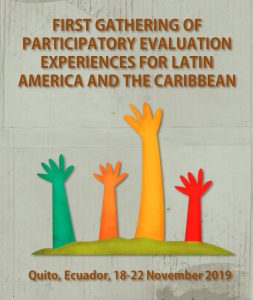
In just five days, we will host the First Gathering of Participatory Evaluation Experiences for the region of Latin America and the Caribbean, and we want to invite you to enjoy the run-up with us.
Over the next few days, we will share everything that we are excited about regarding this gathering. That way, you will participate with us, from our perspective, through our eyes. And by doing so, you will become another one of the participants in this experience.
As you already know, the First Gathering of Participatory Evaluation Experiences for the region of Latin America and the Caribbean will take place in Quito, Ecuador from the 18 to the 22 of November.
Close your eyes (metaphorically! we want you to keep reading this post!) and imagine that you have the ability to teleport yourself. Not just to Quito, but imagine that you had the ability to go, in the blink of an eye, to various places in Latin America and experience different experiences in distinct communities, observe and debate about the roles involved in these situations, get fully informed… and all this through the Participatory Evaluation lens.
Participatory tools are increasingly valued in the field of evaluation whether for analysing reality, facilitating communication, constructing collective perspectives, stimulating creativity and facilitating decision-making, or even for quietening dominant voices to give space for shyer ones. A quick search in the EvalParticipativa tools section is enough to demonstrate that we have a rich supply of techniques and activity ideas. Yet, even though we have a vast array of tools, we do not always know how to use them well. Whilst there seems to be an instrument for every possible situation or goal, there is also the need to constantly modify them and design new customised tools to suit specific situations.
Everyone who has facilitated participatory processes has asked themselves at some point how to achieve maximum possible involvement from as many stakeholders as possible in the activities that we organise. And of course we have not always managed to achieve this! We believe that one of the challenges of participatory evaluation is to create spaces where real participation takes place and multiple stakeholders are the real protagonists in the evaluation agenda.
It is not enough to have a deep understanding of participatory evaluation. It is necessary to identify and use appropriate tools in each social and cultural context where the evaluation is held. These thoughts are a response to this challenge and we are going to share some ideas whilst hoping to provide a pathway for others which will emerge from this community of practice regarding the challenging task of selecting or creating the right tools to facilitate the evaluative process.
Hello friends! Not long now until we have our First Gathering of Participatory Evaluation Experiences for the region of Latin America and the Caribbean, which will take place in Quito, Ecuador from 18 to 22 November 2019.
Motivation
The motivation behind this gathering is in part the recognition that there already exists a diversity of participatory evaluation experiences in Latin America and the Caribbean. Our open call was widely accepted and we have selected 16 experiences of this type of evaluation which we think reflect the great diversity and richness present in our region.
They include experiences which all, explicitly or implicitly, have a clear transformative intention; experiences which encourage the social action participants (whether in a policy, programme or project) to take a leading role in evaluation. We have invited to this first gathering those who have used their evaluative practice to facilitate these processes and to strengthen and build capacity in organisations. Continue reading →
The programme, Servicio País (from the Poverty Alleviation Foundation) started working on Participatory Evaluation (PE) several years ago in a somewhat desperate attempt to conduct evaluations that were more coherent with the programme’s internal logic. It promotes a promotional and collective model which puts local organisations at the heart of development instead of individuals.
Interest in evaluating public policies has grown significantly in the last fifteen years. This is reflected in theoretical and methodological production as well in the increase of national evaluation policies in countries of all continents. It is also seen in the increasing institutionalisation of evaluation and a surge of initiatives focused on making this practice more professional. Since the 2015 ‘International Year of Evaluation’ evaluation has become a global trend. This has made the main international development organisations converge their interests and actions with regional evaluation networks (VOPEs), foundations, various government bodies, non-governmental organisations and academia; all of whom are interested in maximising evaluation as an instrument for improving public policies.
In addition to this, the new Sustainable Development Goals (SDGs) were an important step forward for evaluation theory and practice. With regard to our context, the idea is to generate a new agenda of global evaluation priorities from 2016 to 2030 which aims to bridge the gap between the community of evaluators (supply) and the community of decision makers (demand), giving a central role to civil society as way of ensuring that evaluations do not only respond to the needs of end users but also meet evidence-based quality standards which are credible and can be used to create and manage public policies.
Evaluation is growing in importance in the region. The professional demand from institutions is responded to through focuses and practices which vary in terms of quality and depth. The differences observed in evaluation affects professionalisation and how useful they are for decision-making, learning lessons, accountability and public deliberation on social policies and actions.
In order to address this diversity of realities, international experience demonstrates the importance of having standards which act as guiding references for the professional work of evaluators.
These definitions have been compiled by various organisations, professional associations and cooperation agencies. For example, standards have been defined by institutions belonging to the United Nations; evaluation associations from the USA (AEA), Europe (EES) and Africa (AFREA); and national associations and networks such as those in Germany, Canada, France, Switzerland among others.
They all share core definitions and recognise the shared element inherent to the professional exercise of evaluation, whatever the social or cultural context.
Given the field of evaluation’s relatively recent development in Latin America, it is of upmost importance to have a common guidance framework similar to those in other regions. As well as gathering shared core principles, other dimensions should be considered which are unique and relevant to our rich and diverse reality in Latin America.
For this reason, the Network of Monitoring, Evaluation and Systematisation for Latin America and the Caribbean decided to organise a working group to address this topic and draft the publication, Evaluation Standards for Latin America and the Caribbean. This is available in Spanish, Portuguese and English and is the fruit of the collective work of many people who have contributed their ideas and time. This was achieved with the support of FOCEVAL and the German Institute for Development Evaluation (DEval) who helped organise and run activities.
A few days ago, an animated video introducing the project was launched. It is currently available in two versions (short and extended) in Spanish and one version in English and Portuguese.
English version
Spanish (extended) version
Spanish (short) version
Portuguese version
We hope it will be useful to everyone who is interested in carrying out quality evaluations. We invite you to discover these materials and share them with your colleagues and peers!
Hello colleagues and friends! We wanted to let you know that we have “uploaded” a new evaluation experience that integrates social participation to the Resources section of EvalParticipativa.
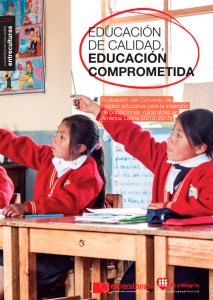
It is called “Mejora de la calidad educativa para la inserción de poblaciones vulnerables en América Latina” (Improving educational quality for integration of vulnerable groups in Latin America), rolled out by Entreculturas and Fe y Alegria, with the support of the Agencia Española de Cooperación Internacional para el Desarrollo (AECID) between 2010 and 2015.
We would like to thank Belén Rodríguez Navas from the Unit of Planning, Evaluation and Quality at Entreculturas for getting involved with EvalParticipativa and sharing this valuable material with us. We would like to invite all those who have participated in similar experiences to share what you have learned with us!
We would like to announce a call to present positive experiences of participatory evaluation developed in Latin America and the Caribbean. Those accepted will constitute the first stage in developing the first regional gathering on the topic, organised byEvalParticipativa, developed by PETAS at the National University of San Juan and the FOCELAC project by DEval, which will take place at the end of November. The country, place and dates are to be confirmed. We will shortly provide more details on the project and this invitation to participate.
In our RESOURCES section of EvalParticipativa, we have created an online repository of materials with a direct and explicit focus on the topic of participatory evaluation in general, and its theory and practice in the region of Latin America and the Caribbean in particular. We would like to share its content with you and invite you to contribute.
The aim of this RESOURCES section within the framework of the EvalParticipativa initiative is to make relevant and useful material from our field of interest available to everyone interested. The resources section includes three sub-sections:
Guides and Manuals, which usually stem from specific experiences of participatory evaluation and which use the lessons learned to highlight benchmarks in the evaluation process. Although some of the documents introduce conceptual discussions, the focus is on how to carry out evaluation processes with social participation.
An online seminar was held on 6 June to share participatory evaluation experiences from the ‘Mesas de Trabajo’ (Working Groups) run by TECHOin Latin America and the Caribbean.
More than forty people from different countries in the region participated. They shared the common strategy designed to evaluate these experiences, highlighting aspects such as the results, process, methodologies, difficulties and achievements.
TECHO is an organisation which works to eradicate poverty in human settlements in Latin America. This is achieved through the combined efforts of residents living in poverty and exclusion and young volunteers.
By working together, they implement projects that respond to the main issues identified in the community such as the need to construct emergency housing, manage access to essential services or construct shared spaces.
Used to determine whether a user is included in an A / B or Multivariate test.
18 months
_ga
ID used to identify users
2 years
_gali
Used by Google Analytics to determine which links on a page are being clicked
30 seconds
_ga_
ID used to identify users
2 years
_gid
ID used to identify users for 24 hours after last activity
24 hours
_gat
Used to monitor number of Google Analytics server requests when using Google Tag Manager
1 minute
__utma
ID used to identify users and sessions
2 years after last activity
__utmt
Used to monitor number of Google Analytics server requests
10 minutes
__utmb
Used to distinguish new sessions and visits. This cookie is set when the GA.js javascript library is loaded and there is no existing __utmb cookie. The cookie is updated every time data is sent to the Google Analytics server.
30 minutes after last activity
__utmc
Used only with old Urchin versions of Google Analytics and not with GA.js. Was used to distinguish between new sessions and visits at the end of a session.
End of session (browser)
__utmz
Contains information about the traffic source or campaign that directed user to the website. The cookie is set when the GA.js javascript is loaded and updated when data is sent to the Google Anaytics server
6 months after last activity
__utmv
Contains custom information set by the web developer via the _setCustomVar method in Google Analytics. This cookie is updated every time new data is sent to the Google Analytics server.
2 years after last activity
_gac_
Contains information related to marketing campaigns of the user. These are shared with Google AdWords / Google Ads when the Google Ads and Google Analytics accounts are linked together.
90 days
Clarity is a web analytics service that tracks and reports website traffic.