2020 GLOCAL EVALUATION WEEK IS COMING

Dear Colleagues, we hope that despite the COVID 19 pandemic and the difficulties brought about by the lockdown and social isolation, you are in good health and motivated to continue learning and sharing information on this evaluation topic that excites us so much.

We are pleased to announce that the events calendar for Evaluation Week #EVAL2020 is now available. As already announced in several forums and networks, this year it will be totally online.

You can see the interactive map on this site , where you can see the online activities that will take place between 1 and 5 June. As you can see, they are ordered by country, but it is possible to participate in any of the events from any of the countries. You will note that there are a number of activities closely related to the broad theme of evaluation and social participation.

Best Wishes!
WE ARE NOT STARFISH, WE ARE CRAYFISH…

who turn up all wet, to walk against the current, stumbling along the way

Hear, hear colleagues!

Here we share the video/memoire of the Gathering of Participatory Evaluation Experiences in Quito, which we have talked extensively about in this community of practice and learning.

The video recalls our work in Ecuador over five days, covering five modules, in order to remind ourselves of the activities and results achieved. It is hopefully useful for communicating what we were doing there, remember each other’s faces and re-live those intense moments of sharing and learning.

Many thanks to Ana Clara Bustelo, from the PETAS team, who managed to summarise five days of intense work in just five minutes. We would love you to share it with your networks and contacts to encourage others involved in participatory evaluation and motivate them to join our community. In the near future, we will share a document summarising the gathering’s contents and conclusions, as well as the work plans for 2020.

Greetings from the EvalParticipativa team! Let’s stay in touch!

RELAC MANAGEMENT REPORT

Dear colleagues,

We wish you all a happy new year!

Many of our EvalParticipativa members are also members of the Latin American and Caribbean Network of Monitoring, Evaluation and Systematisation (ReLAC). In some cases directly, in others through their national evaluation networks. ReLAC is also one of EvalParticipativa’s strategic partners. Therefore, given the link between ReLAC and EvalParticipativa, in this post we want to share ReLAC’s Executive Committee Management Report for 2017 -2019 (Spanish).

As communicated by ReLAC, it focuses on issues that concern ReLAC’s positioning, governance and strengthening within the framework of the ReLAC 2.0 project. In order to move forward in these areas, the Executive Committee is currently preparing a face-to-face assembly, to be held in April/May 2020, with the purpose of co-building and planning ReLAC activities until 2030.

Here is the Management Report  2017-2019 .  If you have any questions or comments, please communicate them to the Executive Committee by email: cejecutivorelac@gmail.com

Bye for now,

EvalParticipativa team.

PARTICIPATORY EVALUATION INSIDE THE TREASURE CHEST

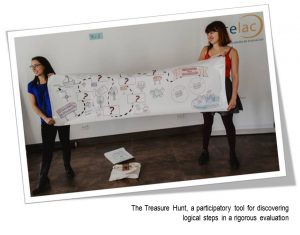
The third day began with a “treasure” hunt! But instead of searching for golden coins, the participants were let loose in the large hotel patios to find elements which make the participatory evaluation process more rigorous and legitimate.

In two groups, the participants looked for cards which featured steps involved in the traditional evaluation process but which also evoke basic aspects of PE. This led to a conversation about the sought-after rigorousness involved in: identifying stakeholders, formulating objectives and questions to gather information, creating working plans, gathering information, analysis and reporting as well as improvement measures.

Continue reading

LEARNING AS A COMPASS FOR PARTICIPATORY EVALUATION

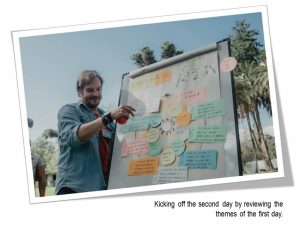
The sun decided to shine brightly, expressing its desire to participate in today’s activities. And so we began the second day in the hotel gardens. We summarised and reassessed the first day’s sessions with an evaluation which went beyond the scope of being a fun activity to enable us to reaffirm that learning is always better when done as a group.

The first part of the morning consisted in presenting three experiences which had the common theme of learning as a tool for collective empowerment.

Continue reading

AT THIS FAIR, THERE ARE NEITHER GOODS TO BE SOLD NOR TRADERS TO SELL THEM ONLY TOOLS FOR PARTICIPATORY EVALUATION

In this First Gathering of Participatory Evaluation Experiences in the region of Latin America and the Caribbean, we will not only speak about PE, its concepts, the roles of those involved and ways of facilitating its processes. We will also host the First PE Tools Fair!

One of the things that all of the case studies selected for this gathering have in common is the use of imagination as the master key.

Through different unpublished strategies, the various participants have promoted and facilitated the development of processes unique to PE. In doing so, the entertaining elements together with the participatory instruments and techniques have enabled and motivated the intervention and involvement of multiple stakeholders.

We are not intending for this activity to be a tool swapping fair for PE, but rather that it will be a space conducive for the collective analysis of the instruments’ limitations, their versatile natures depending on the region and even, who knows, a place where new strategies could be developed.

Put succinctly, tomorrow is the big day! The day we have all been waiting for over the last few months. We are all encouraged and motivated by a common denominator: Participatory Evaluation.

The next few days will be intense as we not only learn more about PE, but also soak ourselves in the experiences lived by our peers and ask ourselves: “What would we have done?” as we admire each of the steps taken.

We will certainly not only be participants in this gathering, but also agents motivated by social transformation and development where we are.

We have arrived in Quito! Welcome to this Tinkunaco, which in Quechua means ‘meeting place’!

EVERYTHING CHANGES, NOTHING STAYS THE SAME; PE TOO!

In as dynamic a reality as the one we are living in, it is imperative that the evaluator adapts to different rhythms. To achieve this, the evaluators must promote tools to facilitate PE processes. But, how do you do this?

During this First Gathering of Participatory Evaluation Experiences in the region of Latin America and the Caribbean, we will constantly ask ourselves about our role as evaluators when facing changeable and unique realities such as those which affect our region. We will mainly focus on how we should act when confronted with these “forks in the road” which appear overnight. In other words, we will focus on seeing ourselves not just as evaluators but also as facilitators in PE processes.

In these exchanges, we will learn to go a little faster than time itself so that in addition to getting a head start on future unpredictability, we can also know how to give a leading role to the multiple stakeholders involved in this evaluative process.

This task is the opposite of simple. For this reason, we will dedicate a whole day to working on this new element involved in being an evaluator and we will examine each of the participant’s experiences.  By doing so, we will create collective tools so that we are prepared, and can prepare for, these continual learning processes which will then be converted into transformative and facilitative knowledge for PE.

How exciting that we are about to meet!

NEITHER RECIPES NOR RECIPE BOOKS

One of the themes which will intersect the First Gathering of Participatory Evaluation Experiences for the region of Latin America and the Caribbean is that of how to conduct PE. Is there only one way? What factors do you have to take into account? What to do when confronted with unexpected situations?

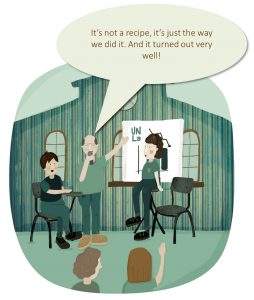
The truth is that there are no magic recipes which can be used to come up with universal solutions for every unexpected moment when conducting PE. Nor will we present an exhaustive guide on how to conduct PE in specific circumstances. Rather, what we aim to do is to collectively construct a basic method which can be altered to suit the characteristics of each situation, context and particular case.

In doing so, through reflective practice, we will observe and analyse each step, the roles of each stakeholder and each stage. We will obviously also emphasise the potential difficulties and limitations. As they say: a smooth sea never made a skilled sailor.

Quito, we are on our way!

PARTICIPATORY EVALUATION HAS THAT ‘JE NE SAIS QUOI’

They say “each follows their own rulebook” but what would happen if we converted these different viewpoints and approaches into a common shared perspective? At this First Gathering of Participatory Evaluation Experiences for the region of Latin America and the Caribbean  we will attempt to do just that.

But we must insist: By saying that, we are not suggesting that we intend to develop a general definition and by doing so, simplify it. Let’s be honest: No, just the opposite! In line with the horizontal action proposed by PE, we aim to propose a space where everyone can share their distinct perceptions, concepts, ideas and appreciations of PE.

In this way, we will be able to shine a light on those defining features which are repeated in the region. We will almost certainly dare to call some of these PE principles in our quest to be disruptive, but we will also be happy to observe any unique characteristics which make an evaluation truly participatory.

All participants will use their own experiences to discover how their realities take on different lights when viewed through the eyes of PE.

Bye for now!

THE SHOES OF PARTICIPATORY EVALUATION, THE FEET OF THE EVALUATOR

Can one experience represent all experiences? Who walks the path? Does PE establish the path or does the evaluator open the way? Over the next few days, we will try to answer these and other questions.

The leading role for this gathering is given to the experiences themselves. Over 5 days, using 15 experiences with evaluator peers, we will be able to zoom in on PE through their eyes despite the fact that they have been carried out in various regions.

Aside from the quantity and diversity of experiences, their value lies in the fact that they were and are transformative in their communities. In such tumultuous times as those today in our region, this is no mean feat. Through the stories, we will be able to observe the tools used, feel the challenges experienced and understand through their experiences that one PE is not the same as all PE.

Continue reading