by Alcides Gussi, Marcia Braz & Regislany Morais
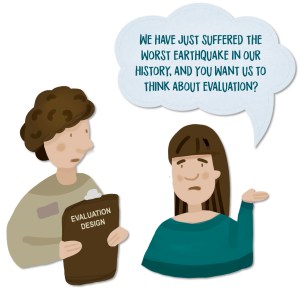 The contemporary debate on evaluation and participation in humanitarian action is particularly prominent in Latin America. Multiple and diverse humanitarian contexts, crisis types and humanitarian responses exist in the region. It is also home to several study centres and researchers who discuss participation.
This is unsurprising given that the region is the birthplace for major theoretical influences on the topic. Moreover, professional evaluator networks have been established where highly diverse evaluation perspectives are shared, contributing significantly to the construction of knowledge and emphases given in the field of evaluation.
All this context strengthens a rich exchange of knowledge and experience on humanitarian action, evaluation and participation in Latin America. In this article, we will briefly introduce these concepts and invite those interested to get involved in the work developed in Brazil by the Humanitarian Action Evaluation Studies Group.
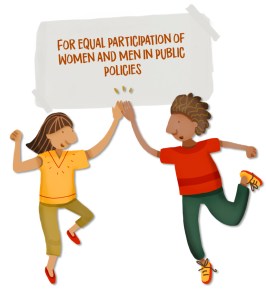 Citizen participation is the best way to achieve social inclusion. It is, after all, one of the goals included in the UN’s Sustainable Development Agenda (SDGs). More specifically, it aims to promote peaceful and inclusive societies that can achieve sustainable development, facilitate access to justice for all people, and build effective, inclusive and accountable institutions at all levels. Gender equality is another important goal to ensure the full and effective participation of women and equal leadership opportunities at all decision-making levels in political, economic and public life.
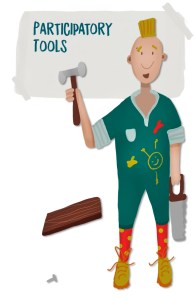 Those of us who have facilitated participatory processes, have at some point wondered what we need to do to achieve the highest degree of involvement possible, from as many stakeholders as possible, in the activities that we plan. One of the many challenges that surface when carrying out participatory evaluation is how to create spaces for real participation where multiple stakeholders can be true protagonists in the evaluation agenda. We know that this is not achieved only by understanding in depth participatory evaluation and the methodological steps, it is also necessary to identify and be able to handle appropriate tools for each social and cultural context where the evaluation is carried out.
 In this article, I’m going to share some thoughts concerning a systematisation experience that involved stakeholders with varying degrees of training. I will draw particular attention to the engaging tools used to promote analysis and reflection.
 Today we would like to share with this community of practice and learning, EvalParticipativa, the experience and perspective of the international organisation
 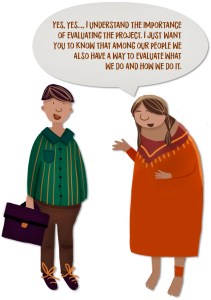 Our region has spent years developing alternative ways of thinking about evaluative processes, deconstructing ways of thinking and doing. This has introduced interesting debates that have led us to reflect not only on how to evaluate but also on who should evaluate (and from what knowledge and what feelings).
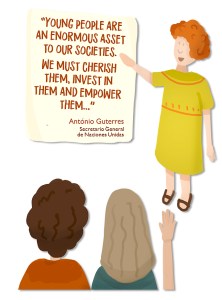
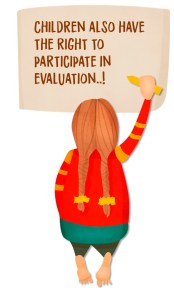 My participatory evaluation research journey was sparked by a motivation to involve young children, as the beneficiaries of an educational program, in evaluating their pre-school program. I wanted children to have the opportunity to participate in designing and using evaluation processes, so as to have their voice heard and to impact on programs and activities they were involved in.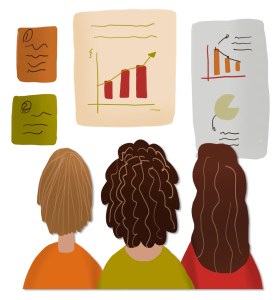

 The imperative