by Esteban Tapella
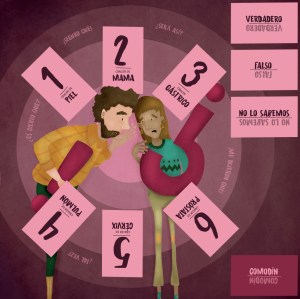 This tool was designed for the participatory evaluation of the Cancer Prevention and Treatment Services in Valle de la Estrella, carried out in 2016 and 2017 in the province of Limón, Costa Rica.
The evaluation was promoted by the Evaluation Capacity Development project (Foceval) and implemented by the German Institute for Development Evaluation (DEval) together with the Costa Rican Ministry of Planning and Economic Policy (MIDEPLAN).
It also had the support and participation of the Defensoría de los Habitantes (Costa Rican Office of the Ombudsman) and the Costa Rican Department for Social Security (CCSS). As the report (Spanish) details, different participatory tools were used in the evaluation, including the Myths and Beliefs About Cancer game.
AIM
The Myths and Beliefs game was designed to address the issue of cancer with villagers who had no medical training. The purpose of the game was to share opinions and reflect on the myths and beliefs people in the area held about the disease. It also made clear which of these beliefs are true from a medical perspective and which are not. The game was used in the evaluation to assess the success of cancer prevention and health promotion campaigns. Given the educational utility of the tool, it was later adapted by the CCSS and used in new prevention campaigns implemented by Costa Rica’s Integrated Primary Health Care Teams (EBAIS) and the Health Boards.
A GAME TO PROVOKE THINKING
The tool was designed in the format of a simulation or thought-provoking game. Frequently —almost exclusively indeed—games are only used in evaluations to motivate groups, as icebreakers, to introduce people to each other or to encourage moments of relaxation between work sessions. In our example, the thought-provoking game goes beyond these recreational, motivational and entertainment purposes. Furthermore, it is not used in a way that requires people to take on an unfamiliar role, removing them from situations they recognise to enter an imagined world. Thought-provoking games respond to the question of how to deal with complex issues in an ‘educational’ manner that contributes new information while requiring not only prior knowledge and professional experience but also personal opinions and individual choices to be expressed in a horizontal, participatory manner, without imposition.
Thus, thought-provoking games do not come with a motivational agenda, nor is the aim to provide healthy, innocent entertainment with a constructive moral ending. Rather, they are intended to be tools at the service of the evaluation process. They seek to reproduce the conditions of each situation as faithfully as possible, whether this be the everyday life of a family, group or organisation, the occupational settings of workers, professionals or grassroots leaders, the operation of the market or the struggles of different sectoral interests within society. The games are intended to incorporate elements that occur in the real lives of participants, allowing them to represent themselves, by ‘living the game’, ‘playing their lives’ or, in other words, by ‘playing seriously’.
Thought-provoking games create conditions that encourage communication, the expression of feelings, experiences, knowledge, ideas and expectations and also to learn about things in a non-hierarchical manner. This makes it possible to relive past moments in peoples’ lives, workplaces and organisations. The rules of these games facilitate exchange and help us discuss complex topics that would not otherwise be addressed if we were not ‘drawn in’ by the game dynamics. Thought-provoking games are designed to facilitate communication, ensuring that different social actors are able to express themselves.
GAME FORMAT AND MATERIALS
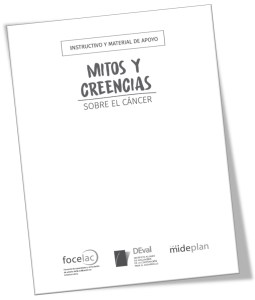 The game consists of an instruction and help manual (currently only available in Spanish) which has five sections: (1) instructions for facilitators, (2) instructions for participants, (3) glossary of difficult terms, (4) medically accurate answer sheet, and (5) table to assess the results in sessions aimed at measuring the impact of cancer prevention and health promotion campaigns.
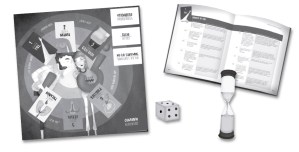 The game also includes:
You will also need a dice and an hourglass (or timer) set to run for a minute.
RECOMMENDATIONS
The format of the game and the content of the cards has been designed for this specific case and context. It will need to be adapted if it is to be used in other contexts. The same format can be used to address other topics. Whatever the case, it is very important to have a clear idea of the topic and of the aims of the exercise, and to define beforehand how far we want to go in terms of the level of reflection in the activity. It is important to be able to ‘feel’ the situation, have a sense of the extent to which the group is ‘engaged’, taking into account the concerns of the participants, as well as the level of enthusiasm for the discussion that is generated. Sometimes it will be appropriate to let the discussion flow if we think it is productive. At other times we will have to be strict and end debates if we see that they are ‘getting out of hand’ or deviating from the original focus, so as not to hinder the sequence of planned activities.
It is also important to keep in mind that the use of simulation or thought-provoking games should help us to develop a sense of collective identity, teaching us to think critically and actively, stimulating collaboration, responsibility, autonomy and creativity. It should also allow us to overcome fears and inhibitions, resolve tensions and create an atmosphere for collective expression and development. To achieve this, we must design every aspect of the tool carefully—its content, every card, the vocabulary—and test it several times before using it in a real evaluation. If we do this, it is more likely that it will facilitate communication and trust, and stimulate active participation and cooperation.
The following testimonial video (in Spanish with English subtitles) provides a description of the tool and its use in participatory approaches.
Idea, content and design: ESTEBAN TAPELLA
Illustrations: ANA CLARA BUSTELO
Graphic design: MARIA CLARA GRAFFIGNA
Content review and production: Focelac ‘Strengthening a Culture of Evaluation and Learning in Latin America’ and the CCSS (Costa Rican Department for Social Security)
Copyright pending. Reproduction in whole or in part is permitted provided the source is properly acknowledged.