New inter-learning opportunities to strengthen National Evaluation Systems
by Celeste Ghiano
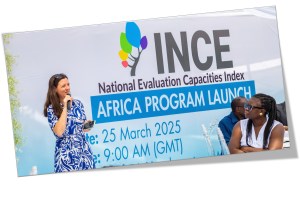
 During the last week of March, I had the privilege to participar as a consultant for the World Food Program in the Launch of the first pilot of the Index of National Capacities in Evaluation (INCE) in six countries in Africa.
This privilege is an enhanced fruit of my participation in the first workshop to create the INCE in and for Latin America in 2019. From there, I was hooked on this initiative that promotes the strengthening of National Evaluation Systems. That is how I was invited to participate as a consultant for its development and then to carry out the pilot test. Currently, I continue to be part of this exercise that has already taken up to three measurements in some of the eleven countries that already use this tool to self-evaluate their evolution, enhance their strengths and work on the challenges they still present, as well as learn from other countries.
For some time now, some interested parties from other latitudes have been watching us with great interest. And from 2025, with the support of partner organizations, we are starting the first pilots in Asia (Sri Lanka and Mongolia) and Africa (Benin, Congo, Morocco, Ghana, South Africa and Tanzania). On this occasion, I had the pleasure of co-leading with Juan Carlos Sanz -DEval- the training and planning workshop for the implementation of INCE in the first six African countries, as well as a beautiful Launch event organized by the African Evaluation Association (AfrEA).
WORKSHOP CONTENT
 The agenda was as full of activities as it was challenging. We started working on a first approach to the interpretation that the participants (government representatives and local consultants) had of a National Evaluation System. One of INCE’s premises is that the instrument must maintain standardization of its form – in order to be able to compare the system and its elements over time and among different experiences – while at the same time allowing for interpretation from the local reality. This was the greatest challenge, which we decided to face collectively with the local referents, in a wise decision to maintain a structure with a flexibility that achieves legitimacy through contextualization.
The second day was devoted to testing the questionnaire, INCE’s main instrument for collecting information. In this exercise we found that it is essential to review ways of calling the processes and interpreting them not only in terms of language and translation (at least into English and French) but also in terms of the organizational culture in six different countries.
During the third day, we focused on learning about experiences in the INCE application process and the use of its results – for decision making at government levels, as well as for research and development of new contextualized perspectives – in Latin American countries. I felt very honored to be able to share the lessons that colleagues from our region have shared with us. This exercise opened a door to future exchanges between Latin America and Africa in the strengthening of Evaluation Systems and their capacities. Finally, this day also allowed us to performativize scenarios that the teams could face during the INCE management process – in technical and political terms. Spoiler alert: we share the same challenges and the same ways of addressing them.
On the last day we set out to collectively define the work path for this pilot test. We were surprised to see the willingness and ability of these teams to set up short and medium term timelines. Although we warned about the importance of taking as much time as necessary. That the instrument will be there, always to collaborate in empowering the Evaluation Systems, towards better public policies and development plans.
Now we have the teams ready to experiment the INCE in some countries of Asia and Africa. And we are looking forward to learning from this new experience. In the meantime, we invite you to see the photo gallery of this meeting.