by María Alejandra Lucero Manzano
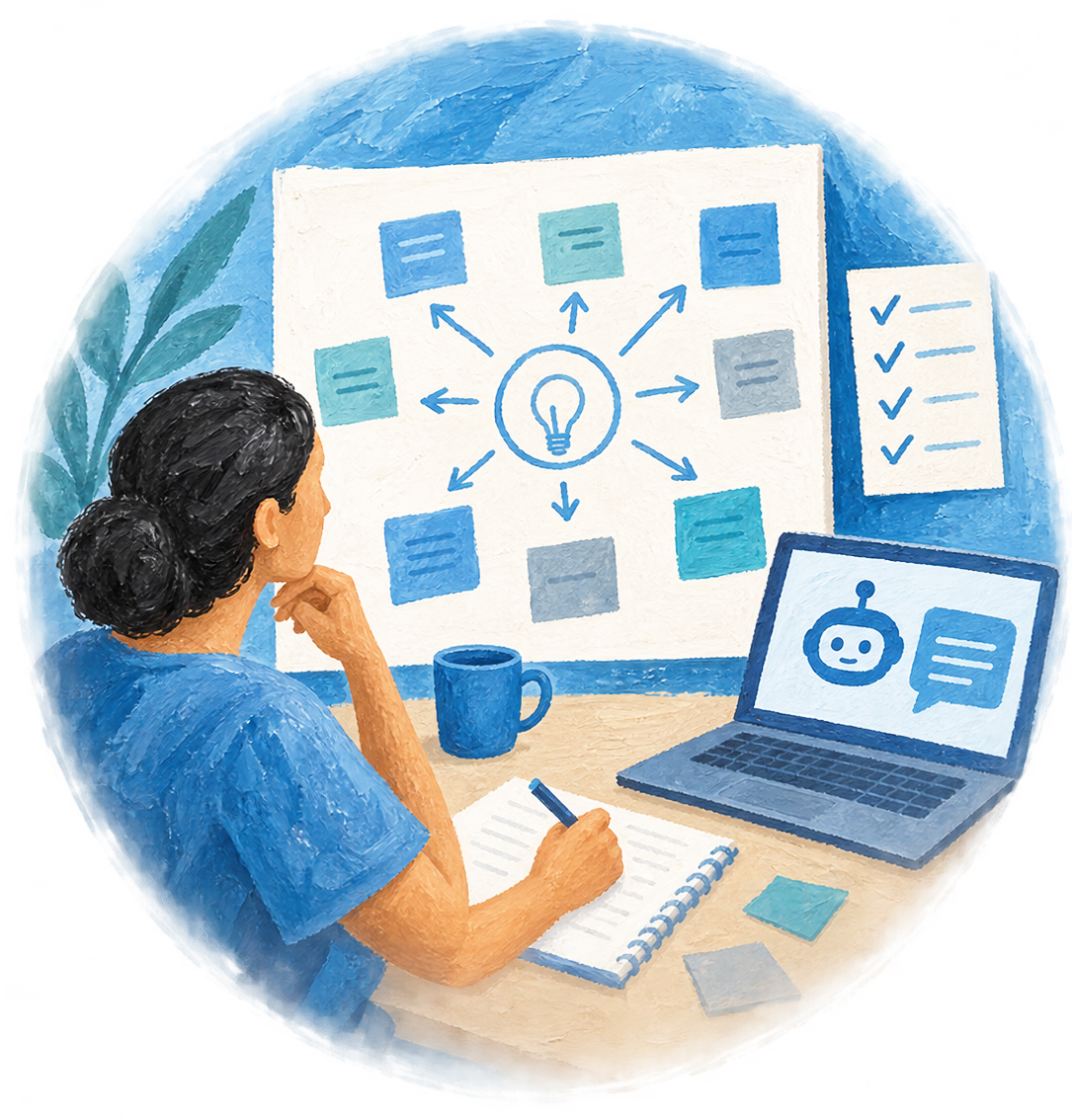 Only a few days remain before the workshop, and there are still many issues to resolve, decisions to make, and a proposal to fine-tune. This time, we have a group bringing together a diverse range of people: community members, municipal technical staff, and young people from the communities involved in the project. We need to design activities that facilitate and encourage dialogue without fear of judgement, prepare accessible materials, and anticipate specific arrangements in case the group atmosphere is not particularly conducive.
Anyone who facilitates this kind of space will remember the stress of these days, when circumstances can change and, with them, the methodologies and activities we have proposed. Yet designing a participatory workshop is rarely the methodological problem it may appear to be at first sight. Above all, it is a time problem that becomes particularly pressing in the days leading up to the event.
This is where artificial intelligence begins to have a concrete place in the participatory evaluation toolbox. Yes, as a tool that can help us arrive with a fresher mind for what really matters and what no AI can resolve: reading the atmosphere in the room, holding silence when necessary, noticing who has not yet spoken, and making adjustments in response to unforeseen situations.
So, how can AI support us in facilitating spaces for debate and reflection, and what are the things we should definitely keep under our own judgement? Let us see…
AI in the workshop preparation phase
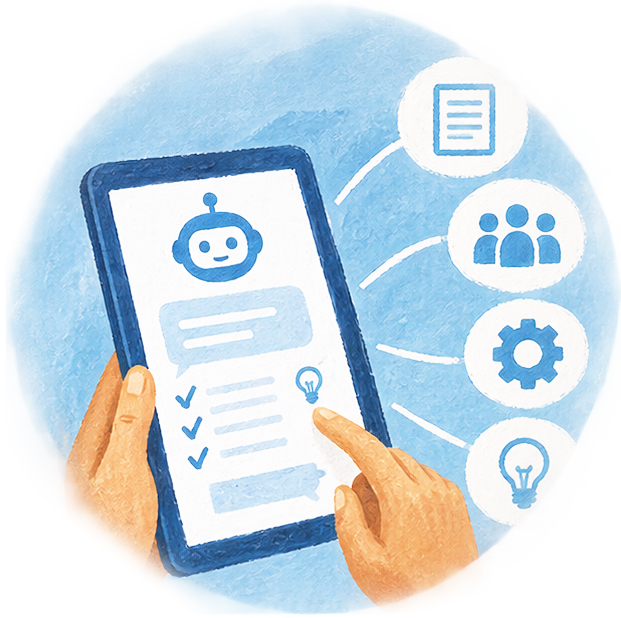 This is one of the moments when AI can be most useful. However, if we do not know the context and specific characteristics of the case we are working with, we will only get generic proposals. It is therefore very important to make these conditions and characteristics explicit so that AI tools can truly show their potential.
How can it help us? Here are some options:
- Systematising prior inputs
When there are already exploratory interviews, responses to a registration form, or notes from coordination meetings, organising this material around thematic areas allows us to arrive with a well-honed agenda. AI’s ability to detect patterns can help us examine more precisely what is not immediately visible and what would take us longer to analyse in the days leading up to the meeting.
It can also help identify the expectations people bring, which often do not coincide with those of the evaluation team. In this way, we can adjust the proposal so that it responds to those expectations and improve our understanding of the shared objectives of these spaces.
- Adapting activities to a specific group
The same participatory mapping technique works differently with adolescents than with older people, or with a group that already knows one another than with one meeting for the first time. Describing the context in detail (how many people, their ages, languages, previous history with the convening institution, and literacy levels) and asking for three variations of the same technique speeds up a task that previously meant hours of searching through manuals.
The result is not used as it stands: it serves as material from which to choose and discard. This option can help us identify alternatives we had not considered, make our own assumptions and biases, as well as those of AI, explicit, and even review previous materials that may require further adaptation.
- Translating the technical language of a project
Although this is often something we may already have internalised, it is always useful to ask ourselves to what extent the project can be easily understood without resorting to technical language, particularly when participants do not share that language.
Turning a logical framework or indicator matrix into questions that make sense to participants is as much an exercise in cultural translation as in linguistic translation. “To what extent did the programme contribute to strengthening organisational capacities?” is not a question for a community discussion. “What can people do in the neighbourhood today that they could not do two years ago?” is.
With AI tools, we can have that first draft in minutes; review by someone who knows the group remains indispensable, because local vocabulary is not contained in any training corpus.
- Anticipating scenarios and preparing fallback plans
Asking the tool to play the role of a sceptical participant, or to list what could go wrong in a prioritisation activity with a divided group, can work very well as a rehearsal for anticipating strategies. It is true that we cannot foresee everything that may happen, but we can anticipate possible pathways and reflect on foreseeable tensions. Sometimes these tensions are implicit in the previous data, and identifying them can help us think of alternatives if necessary; at other times, they will be part of our ability to read the group’s atmosphere: the person who monopolises the conversation, the conflict between two organisations present, or the local authority who appears unexpectedly and changes the atmosphere in the room.
- Producing visual and multilingual materials
Facilitation guides, activity cards, illustrated agendas, instructions for the support team. Content that previously had to be left out because there was not enough time or budget for design can now be produced quickly and adjusted as needed. However, it is very important that we draw on our own creativity in producing it. Let us remember that AI works from patterns. Therefore, if we leave no room for our creative side, we run the risk of producing mass-produced material whose impact will be weaker, because the human element that conveys ideas and enables us to connect with others will be absent.
In multilingual contexts, this opens the door to materials in Indigenous languages that otherwise might never have been produced, always subject to review by speakers from the community.
AI during and after the workshop
During the workshop, AI can perform other functions, which will also depend on our own decisions about how to use it.
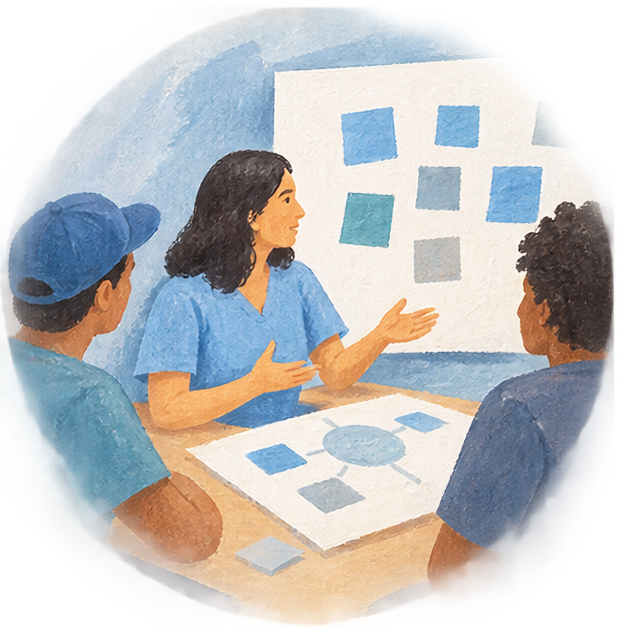
Perhaps we can think of it as a note-taking assistant. At present, particularly for online workshops, its use for assisted transcription and the preparation of meeting summaries is very common. This can be useful at the end of the first day, to give the group a summary of what was covered before starting the second. This back-and-forth is also a form of validation.
However, this support is not advisable in a face-to-face workshop. In this case, we can use AI as a “memory palace”, asking it to organise our ideas and perceptions using voice mode. This structure can then be turned into a graphic piece that summarises what was discussed clearly, coherently and visually, in a short time.
After the workshop, we can draw on various techniques through which AI speeds up the preliminary coding of qualitative material. Nevertheless, it is important to remember that our own active participation, and our capacity for reflection and critical analysis, will remain key, because AI cannot capture the subtleties of either verbal or non-verbal language.
AI can also support us in producing feedback in different formats according to the audience: a report for the funding institution, an infographic for the participant group, an audio recording for those who find reading difficult, or material translated into other languages to help guarantee the right to knowledge and information. Tailored feedback is a long-standing debt in evaluation, and here we have a concrete opportunity to address it.
What cannot be delegated
Angie Pereira Calvo made this point recently in this same space, drawing on a two-hour conversation with a group of women, without a recorder or questionnaire: there is something about the quality of listening that no system can yet capture. AI can help prepare the ground for that conversation. Even when we encounter applications capable of “talking” with people, AI cannot sustain such a conversation, much less truly understand the different dimensions of what has been said.
The greatest risk is not that the technology will fail. It is that, in order to save time during preparation, we will also standardise what was meant to remain open: the question that arises because someone dared to say something different; the change of agenda when the group needs to talk about something else; the decision not to use the planned technique because the characteristics of the group call for another; the empathy that emerges from a space for listening that does not always exist, the words that are built when we are truly able to pause and express what we have lived.
The decision to use AI in a process
In my recent experience, facilitating spaces for capacity strengthening in AI often ends with an interesting reaction: fascination and surprise at everything people can do with AI. The difficult part comes afterwards, and not necessarily at the moment when each person sits in front of the screen and has to decide what to ask. It lies in being able to identify critically how to use it: what can be uploaded to the tool, what to accept from what it produces, and what to rework. Knowing how to use the tool is not enough. It requires judgement and creativity of our own.
What we see today in reports, workshops and presentations looks far too similar. Slides with the same style, introductions that could serve any other report, workshops that begin with the same brainstorming exercise, and even conclusions or final reflections so similar that they could be copied and pasted into any other document. Everything organised, everything correct… everything boring.
We complete tasks in less time, but that time saved is not devoted to thinking, reflecting or connecting. It is filled with more work, and the result becomes increasingly impersonal. Without our personal touch, without space for the reflections that arise only from lived experience and from making sense of it, the human side becomes isolated.
In participatory evaluation, this matters more than in other fields. AI works with patterns and delivers the “average” of what has already been written. Our experience is the opposite of the average: the words of a woman in an interview that stayed with us throughout the journey home, the doubt that remained after a community feedback session, the silence that fell when we asked about something uncomfortable.
 So, what can we do to counteract this inertia? Before opening the tool, write a sentence of our own about what we want the workshop to invite the group to reflect on, or about what we feel or imagine in relation to the workshop we have to prepare. If we start from AI’s blank page, we start from the average, and the result will be no different.
Then feed it with our own material, in addition to the topic: feelings, field notes, comments from the last meeting, those things that are as particular as they are different. This changes the result even more than any prompting trick.
And treat what it produces as a draft to be dismantled. If we cannot find anything to cross out or change, it is because we are not doing our critical and reflective work. With the time we gain, it is worth writing down what the last workshop left us with: what surprised us, what became tense, what we would change. No tool can write that note.
If we decide to incorporate AI into our work, we need to remain alert to how we are using it. It should be a tool that helps us structure and organise our own ideas, not one that directs our thinking and diminishes our creative capacity. In a workshop, the challenge will remain to build enough trust for the agenda to be broken when the group needs it, to adapt a technique or turn to another one, and to return to the group a structure of what it has built even when time is short. At the end, participants should feel that the space and the time were worthwhile.