by Emma Lucía Rotondo
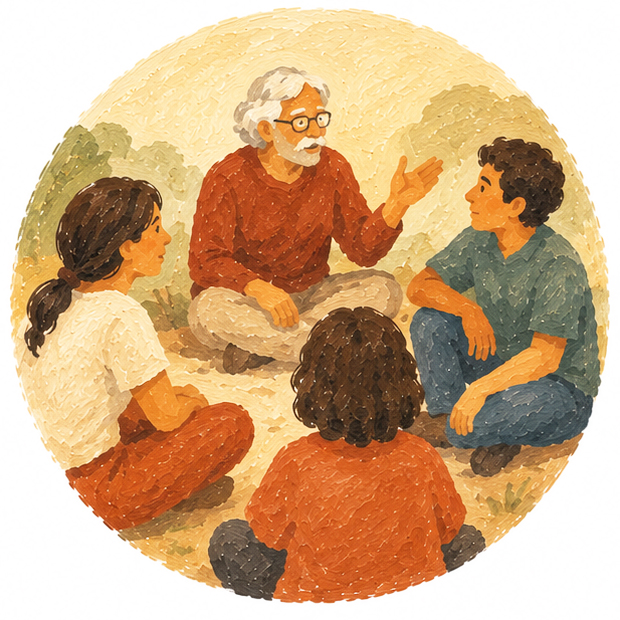 At a time when the field of evaluation is increasingly focused on participation, context, inclusion, learning and complexity, it is worth remembering that many of these concerns have deep roots in Latin America. Long before they became part of the international language of evaluation, Paulo Freire and Orlando Fals Borda were already questioning who produces knowledge, how it is constructed, what power relations are at play, and what purpose that knowledge serves.
Coming from different backgrounds –Freire through Popular Education and Fals Borda through Participatory Action Research (PAR)– they developed approaches that positioned people and communities as subjects of knowledge rather than merely as sources of information.
Reviving these traditions does not mean mechanically transferring their methods to contemporary evaluation. It means asking ourselves what they can contribute to concrete decisions: how we formulate evaluation questions, how we understand changes, how we incorporate the knowledge of those who experience the interventions, and how we produce evidence without separating knowledge from the social, cultural and political conditions in which it is constructed.
From Popular Education to an evaluation that engages in dialogue
Paulo Freire’s Popular Education challenged so-called ‘banking education’, based on a relationship in which some possess knowledge and others receive it. In contrast, he proposed a dialogical and problematising form of education, in which people critically interpret their reality and participate in its transformation. Dialogue, problematisation and praxis are central elements of this perspective.
 Applied to the field of evaluation, this alters a seemingly simple question: who knows what is happening?
The technical expertise of the evaluation team is necessary, but not sufficient. The people experiencing an intervention possess knowledge about its effects, obstacles, changes and unforeseen consequences that can hardly be captured by instruments designed exclusively from the outside.
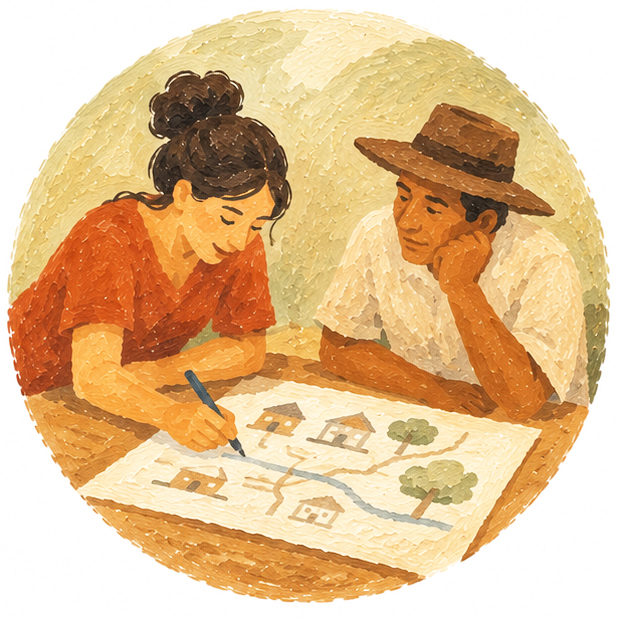
This can take the form of dialogues of knowledge, reflection circles, the problematisation of situations, collective analysis of causes and consequences, maps of actors and relationships, and joint interpretation of findings. But participation does not lie in the technique itself: it lies in the place that people occupy within the process of producing, interpreting and using knowledge.
For example, given the low participation of indigenous women in decision-making forums, a participatory exercise would not have the sole purpose of asking what they think. It could help to explore: what explains this situation? What power relations are at play? Which actors facilitate or hinder it? What strategies have been developed? What has changed and why?
This requires taking the cultural context into account. A technique designed for an urban or institutional context may not be relevant to an indigenous or rural community, nor to populations living in situations of violence. Languages, forms of communication, collective timelines, gender relations, authorities, forms of deliberation and local ways of representing knowledge can all influence the most appropriate way to generate evidence.
From Participatory Action Research to producing knowledge with communities
Orlando Fals Borda developed Participatory Action Research by challenging the rigid separation between researcher and research subject and by linking the production of knowledge with action. His approach was grounded in Latin American social and political realities and developed in dialogue with communities and organisations facing inequality, exclusion and conflict. This foundation is fundamental: PAR proposed a different relationship between knowledge, individuals and social transformation.
For contemporary evaluation, one of its main contributions is the recognition that communities can participate in the production and analysis of knowledge, not merely in the provision of data. This opens up methodological possibilities such as interviews, observation, historical reconstruction, collective memory, social cartography, analysis of actors and relationships, timelines and collective deliberation. However, none of these tools in itself constitutes a Participatory Action Research (IAP).
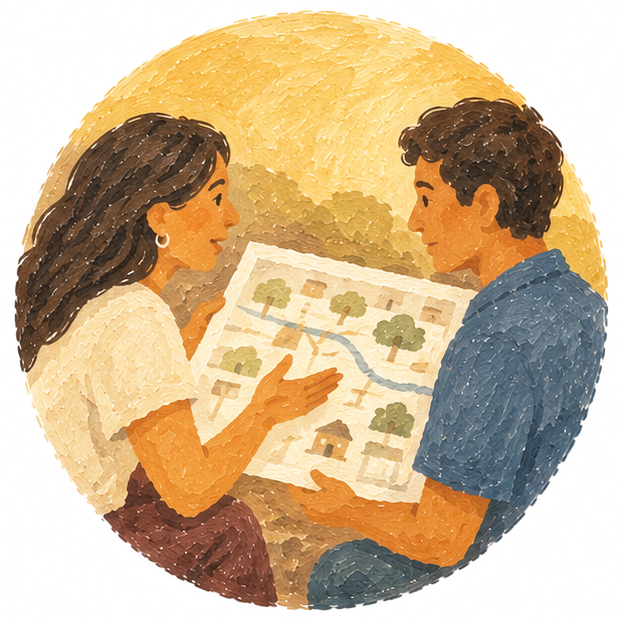 A timeline can reconstruct events, decisions, changes and external factors, but it need not be a conventional line: it can be represented as a path, a river, a tree or a territory. Social cartography can locate actors and resources, but it can also represent alliances, conflicts, risks, power relations or territorial transformations. Collective memory can recover dimensions of a process that do not appear in institutional documents.
These techniques can and must be adapted and reconfigured in collaboration with those taking part. It is not a question of arriving with a fixed formula, but of constructing relevant ways of representing, analysing and communicating what one wishes to understand. This also requires recognising the limits of participation. Time, resources, security conditions, power relations or the institutional mandate may restrict it. That is why it is important to distinguish between an evaluation that merely consults and one in which people have some real capacity to influence the questions, the interpretation or the use of the results.
Understanding change within its context
The contributions of Freire and Fals Borda are particularly relevant for evaluating interventions carried out in areas affected by violence, displacement, territorial conflicts, discrimination, gender-based violence, the recruitment of adolescents and young people by organised crime, or situations following armed conflict.
In these contexts, comparing baseline and end-point indicators may show that something has changed, but does not necessarily allow us to understand how, why, for whom and under what conditions.
Evaluation may need to reconstruct events, identify contextual factors, analyse decisions, recognise strategies developed by communities, and compare the explanations provided by different actors. To this end, timelines, trajectory reconstructions, stories of change, analyses of critical events, maps of actors and relationships, interviews and documentary analysis can be combined.
A story of change can reconstruct how a person, organisation or community moved from one situation to another, what role the intervention played, and what other factors were involved. From this perspective, people’s experiences are not merely testimonies intended to illustrate results. They can help to formulate hypotheses, identify mechanisms of change, understand differences between groups, and explain results that indicators alone cannot interpret.
A living Latin American tradition for today’s evaluation
Freire placed dialogue, problematisation, critical consciousness and praxis at the centre. Fals Borda linked research, participation and transformative action. These are distinct traditions and should not be confused, but they converge on a profound concern: how to produce situated knowledge that enables us to better understand reality and act upon it.
Their contribution to contemporary evaluation does not consist of offering us a catalogue of participatory techniques. It is more demanding: it invites us to re-examine how we understand knowledge, who can produce it and what we do with it.
This involves moving from a conception of participation as mere consultation to one in which, where conditions permit, participants have the capacity to influence the questions asked, contribute interpretations, discuss findings and guide the use of the results. It also involves understanding that context is not merely a section tacked onto the end of the report. It forms part of the explanation for the changes. And that people’s knowledge is not a qualitative supplement to ‘real data’, but a source of evidence that must be analysed, cross-checked and placed in dialogue with other sources.
 From this perspective, an evaluation inspired by these Latin American roots is no less rigorous for being participatory, situated or dialogical. It may in fact be more demanding: it compels the evaluation team to justify its decisions, acknowledge its own assumptions, compare perspectives, take power relations into account and make explicit the limits of what it can assert.
An evaluation takes on greater meaning when it is not limited to establishing what has changed, but rather helps us to understand how it happened, why, for whom and under what conditions. And when that knowledge enables people and organisations to recognise lessons learnt, to question what seemed to be a given, and to open up new possibilities for collective action. Thus, learning is not confined to the evaluation report: it can become social learning, the capacity to critically interpret the experience and to make different decisions in the face of the challenges that remain.
This is where the Latin American roots of evaluation cease to be a thing of the past and become a living practice.