2020 GLOCAL EVALUATION WEEK IS COMING

Dear Colleagues, we hope that despite the COVID 19 pandemic and the difficulties brought about by the lockdown and social isolation, you are in good health and motivated to continue learning and sharing information on this evaluation topic that excites us so much.

We are pleased to announce that the events calendar for Evaluation Week #EVAL2020 is now available. As already announced in several forums and networks, this year it will be totally online.

You can see the interactive map on this site , where you can see the online activities that will take place between 1 and 5 June. As you can see, they are ordered by country, but it is possible to participate in any of the events from any of the countries. You will note that there are a number of activities closely related to the broad theme of evaluation and social participation.

Best Wishes!

WE ARE NOT STARFISH, WE ARE CRAYFISH…

who turn up all wet, to walk against the current, stumbling along the way

Hear, hear colleagues!

Here we share the video/memoire of the Gathering of Participatory Evaluation Experiences in Quito, which we have talked extensively about in this community of practice and learning.

The video recalls our work in Ecuador over five days, covering five modules, in order to remind ourselves of the activities and results achieved. It is hopefully useful for communicating what we were doing there, remember each other’s faces and re-live those intense moments of sharing and learning.

Many thanks to Ana Clara Bustelo, from the PETAS team, who managed to summarise five days of intense work in just five minutes. We would love you to share it with your networks and contacts to encourage others involved in participatory evaluation and motivate them to join our community. In the near future, we will share a document summarising the gathering’s contents and conclusions, as well as the work plans for 2020.

Greetings from the EvalParticipativa team! Let’s stay in touch!

THANKS, THANKS, THANKS!

Greetings friends and colleagues!

Now that all our first EvalParticipativa gathering participants have returned home and are processing everything they have experienced, we are left with mixed emotions! We are nostalgic after our farewell but at the same time thrilled to have met such courageous people, both professionally and personally, and to have heard all about their experiences.

As the gathering’s organisational team, we want to once again thank everyone who got involved and contributed their best so that this gathering was, as so many of you commented, an unprecedented success and amazing experience. We are happy and tired as it required a lot of organisational energy… But oh so very happy! We hope to continue building this new community of practice and learning together. EvalParticipativa belongs to everyone involved and together we will make it grow even more.

Continue reading

THE FAIR HAS COME TO TOWN!

The last day of the First Gathering of Participatory Evaluation Experiences for Latin America and the Caribbean began with an invitation to reflect on the various techniques, tools and instruments used in PE.

Participants took it in turns to select tools that they felt comfortable using and put them into different categories: audiovisuals, narratives, graphics and texts, group/experiential activities. Then, they exchanged their experiences and perspectives on them.

The narrative tools included systematisation, testimonies, journals, the More Significant Change, stories from the future, studies of good practice, lifestyle analysis. Graphics and textual tools included collaborative drawings, transects and maps, stones and fishes, mind maps (of networks, resources and stakeholders), calendars, diagrams and matrices.

For group/experiential experiences, participants proposed simulation games, maps, sociometry, focus groups, collective mapping, community meetings and assemblies, timelines, workshops on varied themes.

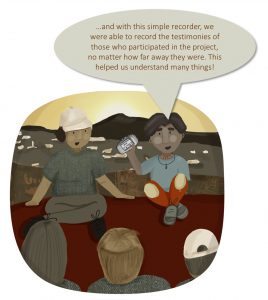
Finally, in terms of audiovisual tools, they focused on techniques which include videos and photolanguage.

Then, armed with advice to practise active listening, we held a conversation over coffee around the following question: What is the main challenge we face in making sure that PE tools and instruments reach their full potential?

Continue reading

THE ART OF BEING A FACILITATOR

One of the most eagerly awaited sessions began with a challenge for those participants who arrived late: to carry out the Make an Eight forfeit, which involved drawing a figure of 8 with their bodies. This was a fun way to start our discussion on the following question: “What are we talking about when we refer to facilitation and facilitators?”.

Using a kinaesthetic version of multiple choice, the participants decided between true and false options regarding evaluation matrices, questions, social action theory, sources and tools.

Jorge Chávez–Tafur ran the session for facilitators and invited us to use introspection and hindsight to evaluate our own practice. He also took us on a tour of accepted international definitions of the term facilitation, which included entries as varied as yanapai -a Quechua term which means help- and Voorlichtingskunde -which alludes to the science of “lighting the way” in Dutch-. Taking into account the diversity of names, which at times shared little in common, he insisted that rather than agree on terms, the important thing was to capture all that they covered: content, effects and impact.

Continue reading

PARTICIPATORY EVALUATION INSIDE THE TREASURE CHEST

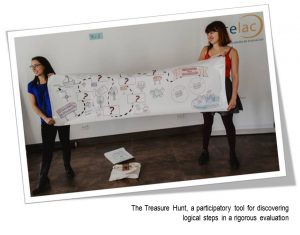
The third day began with a “treasure” hunt! But instead of searching for golden coins, the participants were let loose in the large hotel patios to find elements which make the participatory evaluation process more rigorous and legitimate.

In two groups, the participants looked for cards which featured steps involved in the traditional evaluation process but which also evoke basic aspects of PE. This led to a conversation about the sought-after rigorousness involved in: identifying stakeholders, formulating objectives and questions to gather information, creating working plans, gathering information, analysis and reporting as well as improvement measures.

Continue reading

LEARNING AS A COMPASS FOR PARTICIPATORY EVALUATION

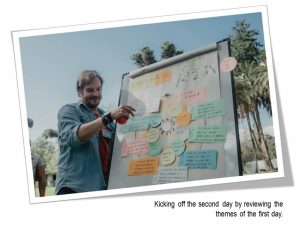
The sun decided to shine brightly, expressing its desire to participate in today’s activities. And so we began the second day in the hotel gardens. We summarised and reassessed the first day’s sessions with an evaluation which went beyond the scope of being a fun activity to enable us to reaffirm that learning is always better when done as a group.

The first part of the morning consisted in presenting three experiences which had the common theme of learning as a tool for collective empowerment.

Continue reading

PARTICIPATORY EVALUATION AS A KEY TO EMPOWERMENT FIRST DAY OF THE GATHERING FROM THE EARTH’S ‘CENTRE’.

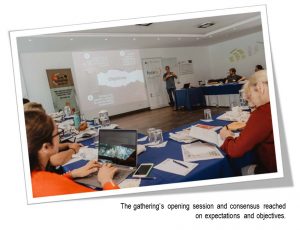
With welcoming smiles and anticipation in their eyes, the participants shared their accents, nuances and idioms around a single topic: their experiences with Participatory Evaluation.

After personal and institutional introductions, one question caught the participants by surprise: “What do I like about myself.

Despite their humility and the fact that they were not used to talking so openly about themselves, everyone agreed on the same characteristics; passionate, intrepid, curious, humble and ready to learn. It was as if Participatory Evaluation attracts all those willing to be disruptive, not only in their personal lives but also in all the domains they come into contact with.

Continue reading

AT THIS FAIR, THERE ARE NEITHER GOODS TO BE SOLD NOR TRADERS TO SELL THEM ONLY TOOLS FOR PARTICIPATORY EVALUATION

In this First Gathering of Participatory Evaluation Experiences in the region of Latin America and the Caribbean, we will not only speak about PE, its concepts, the roles of those involved and ways of facilitating its processes. We will also host the First PE Tools Fair!

One of the things that all of the case studies selected for this gathering have in common is the use of imagination as the master key.

Through different unpublished strategies, the various participants have promoted and facilitated the development of processes unique to PE. In doing so, the entertaining elements together with the participatory instruments and techniques have enabled and motivated the intervention and involvement of multiple stakeholders.

We are not intending for this activity to be a tool swapping fair for PE, but rather that it will be a space conducive for the collective analysis of the instruments’ limitations, their versatile natures depending on the region and even, who knows, a place where new strategies could be developed.

Put succinctly, tomorrow is the big day! The day we have all been waiting for over the last few months. We are all encouraged and motivated by a common denominator: Participatory Evaluation.

The next few days will be intense as we not only learn more about PE, but also soak ourselves in the experiences lived by our peers and ask ourselves: “What would we have done?” as we admire each of the steps taken.

We will certainly not only be participants in this gathering, but also agents motivated by social transformation and development where we are.

We have arrived in Quito! Welcome to this Tinkunaco, which in Quechua means ‘meeting place’!

EVERYTHING CHANGES, NOTHING STAYS THE SAME; PE TOO!

In as dynamic a reality as the one we are living in, it is imperative that the evaluator adapts to different rhythms. To achieve this, the evaluators must promote tools to facilitate PE processes. But, how do you do this?

During this First Gathering of Participatory Evaluation Experiences in the region of Latin America and the Caribbean, we will constantly ask ourselves about our role as evaluators when facing changeable and unique realities such as those which affect our region. We will mainly focus on how we should act when confronted with these “forks in the road” which appear overnight. In other words, we will focus on seeing ourselves not just as evaluators but also as facilitators in PE processes.

In these exchanges, we will learn to go a little faster than time itself so that in addition to getting a head start on future unpredictability, we can also know how to give a leading role to the multiple stakeholders involved in this evaluative process.

This task is the opposite of simple. For this reason, we will dedicate a whole day to working on this new element involved in being an evaluator and we will examine each of the participant’s experiences.  By doing so, we will create collective tools so that we are prepared, and can prepare for, these continual learning processes which will then be converted into transformative and facilitative knowledge for PE.

How exciting that we are about to meet!