By Patrick Okwen, Nange Lisette & Leonel Ayafor
Prelude to the Two Rivers
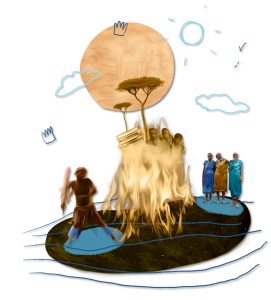 “Once upon a time on the planet Earth, science gathered loads of data from hard work by assiduous scientists. Unfortunately, this data was hidden behind barriers of complex scientific terms, financial paywalls, and languages that were not comprehensible to everyone. This River of Science flowed downhill but was not accessible to all. Then came the River of Stories, the storytellers worked with researchers to break down scientific language into stories, remove paywalls, and tell science stories in simple local languages. The two rivers flowed downhill and were now accessible to all” (Le Nomade).
Science has progressed significantly over the past century. In the 21st century, our society has been tagged “an experimenting society” with four identified waves of the evidence revolution. There has also been a self-awakening in the African context with the ‘ubuntu’ concept of “Made in Africa Evaluation. However, science and scientific data also faced their biggest adversary during this same time –mis/disinformation– also referred to by several terms including conspiracy theories, fake news, alternative truth, myths, rumors, etc. Meanwhile, scientific data is complex and usually available in English, authors of mis/disinformation create simple stories in local languages and make them available on both digital and non-digital platforms.
The Complexity of Science Data
Research is meant for consumption by the public or citizens, practitioners, and policymakers. However, because of the complex nature of scientific reports, they are usually too complex for their intended audience. Researchers therefore end up speaking to each other with complex terms and graphs. In addition, most research is published in English as this increases readership, visibility, and citations. Leaving behind the rest of the non-English-speaking world. To further complicate this situation, most research reports are locked behind paywalls. While open-source journals require a fee to be paid by authors, this has a risk of keeping out relevant research reports by authors from LMICs.
The Simplicity of Storytelling
Storytelling is a universal human family culture used to communicate, educate, and entertain. The simplicity of storytelling ensures that the audience is engaged and understands the messages intended by the storyteller. Stories are usually short, adaptive, contextualized, and non-confrontational. But storytelling is not as straightforward, it is an art that has evolved and morphed through human existence. The African storytellers believe that ‘a storyteller cannot tell a story to an audience the storytellers do not know’. This old human tradition needs to be upheld and evolved into current human trends of science. The African storyteller Chinua Achebe maybe puts this quite well when he says “When a tradition gathers enough strength to go on for centuries, you don’t just turn it off one day”.
Evidence Tori Dey
In the African tradition, the storyteller is an oracle – they can see things that are yet to happen. Perhaps the African storyteller Ben Okri puts this concept quite subtly when he says “The mind cannot conceive what the eyes have never seen”. Or George Orwell’s “Nineteen Eighty,” which tells a story of years to come. Storytellers have the power to see beyond what human eyes conceive and develop stories out of these. Evidence Tori Dey (ETD) seeks to provide the storytellers the resources they need to reach complex scientific data, practice data, and lived experiences and use these to craft stories of science. Today’s storytellers thus have an opportunity to exploit science’s richness and build on science stories. In essence, several ‘influencers’ on social media sometimes use storytelling concepts unknowingly. Sadly, the storytelling space on social media is overwhelmed by mis/disinformers.
ETD is an indigenous African approach to generating, translating, and communicating scientific data in a way that is engaging, interactive, educative, and entertaining. It was developed at eBASE as they struggled to communicate research evidence to the public, policymakers, and practitioners. It is a systematic, collaborative, and sustainable approach that consists of seven steps, with six of these steps in a continuous cycle.
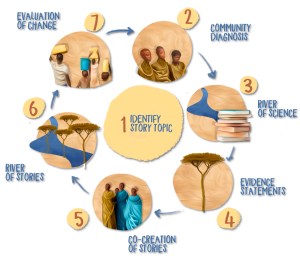
The seven steps are: 1. Identify a Topic. 2. Community Diagnosis. 3. Evidence Synthesis. 4. Evidence Statements. 5. Co-Creation of Stories. 6. Telling Stories. 7. Evaluation of Change. The process has received several funding in its conception and development including funding from the Education Endowment Foundation, The French Embassy in Cameroon, Grand Challenges Canada, and the Canadian Institute for Health Research. It has now been piloted for gender-based violence and COVID-19.
The Comings of the Two Rivers
In ETD, we consider two rivers. First, there is the River of Science. The River of Science is the data generated from research and practice. This includes data from synthesized evidence in systematic reviews, lived experiences gathered through qualitative research or storytellers’ diaries, and practice data from ministries for example, in DHIS2 data or development agencies reports. The River of Science is usually a complex flow of numbers, jargon, and complex non-emotional graphs. We often see ‘effect sizes’, ‘confidence intervals’, ‘forest plots’, etc. Secondly, there is the River of Stories. The River of Stories is generated from the creativity of artists or storytellers and can be in the form of narrative stories, poems, dance, song, and miming. The objective of the two rivers is to improve knowledge with the assumption that improved knowledge is a first step to behavior change and has the potential to move individuals up the stages of the transtheoretical model of behavior change. Meanwhile, the River of Science is usually cold and lacks emotions in its numbers and graphs, the River of Stories is more interactive, entertaining, and rich in emotions and colors. The concept of storytelling is aptly put in the words of Joseph Campbell “People forget facts, but they remember stories”.
The comings of the two rivers seek to move a community or an individual up the stages of change using the transtheoretical model for behavior change framework as a guide. Depending on the stage of change of the community or individual, stories could employ other behavior-change techniques like the information-motivation-behavioral skills model; theory of reasoned action; theory of planned behavior; social-cognitive theory; control theory; and operant conditioning. The stories can therefore approach a community or individual through the influence of knowledge, intentions, self-efficacy, attitudes, or behavior.
Inoculation Stories
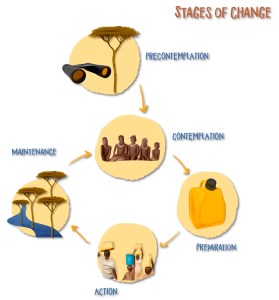 Inoculation stories demonstrate the creativity and engagement that is at the heart of storytelling. Inoculation stories are stories generated from community stories collected in storytellers’ diaries and then used to develop stories that heal. A community that is in denial or pre-contemplation may have stories that include barriers to science data uptake, these barriers are incorporated into stories that highlight coping strategies. When these stories are recounted to the community, they can see themselves and their decisions in the lives of the characters in the stories.
In a vaccination (Zero Dose) project conducted in Bali, Cameroon, storytellers told stories of a woman who did not vaccinate her kid because she was busy planting her crops. During the pre-harvest season, however, the baby fell sick with a vaccine-preventable disease (tetanus) and became permanently disabled. The baby remained in the hospital for long periods, so the mother was unable to nurture her crops. In the end, she lost more to the vaccine-preventable disease. This character contrasted with a character that dedicated time to a vaccine and had a healthy baby and therefore more crops. This story was able to move a community from PREPARATION to ACTION.
The Storytellers Diaries
When storytellers tell stories during storytelling events or household visits, they encourage their audience to tell their own stories on the topic. These stories include GREEN (in line with scientific data) and RED (in conflict with science data) stories collected in paper or audio diaries. The storytellers are usually local community members with an understanding of the community and its culture, who speak the local language, and who are preferably within existing structures. The storytellers keep a diary that gathers stories over time. These could be full stories, memos, or check boxes of the number of GREEN versus RED stories. Over time the storytellers monitor how the community is evolving in terms of GREEN versus RED stories. This is an indigenous knowledge generation process that is contextually appropriate and removes power dynamics between the researcher and research participants. There is of course a need to further develop and validate this process.
Storytelling and Behavior Change
ETD uses behavior change technics to understand communities to better translate and communicate scientific data. It also uses community stories to observe community change along the transtheoretical model of behavior change over time. This is based on the Behavioral Change Technics Taxonomy originally developed by Abraham and Michie. Storytellers, community members, and researchers collaborate to co-create stories that speak to a community’s stage of change. These stories are developed on a story template (technical file) which highlights the behavior change techniques used in the story and how these will potentially bring about change.
Conclusion
ETD is a systematic, interactive, and indigenous approach to knowledge generation, translation, and communication developed to respond to equitable and contemporary scientific data communication needs. It has been piloted in two projects by eBASE Africa and requires further research to validate the innovation.
One thought on “The Comings of the Two Rivers: Storytelling Science Data”