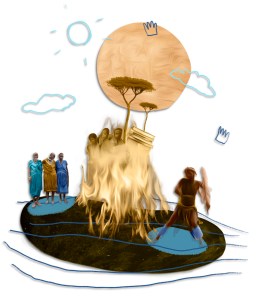
At the beginning of 2024 we shared the article “The arrival of the two rivers. Scientific storytelling”, in which we analyzed the role of stories rooted in each community when it comes to linking scientific advances and the dissemination of knowledge with the work of local populations, their culture and their impact on research and -why not!- the evaluative field.
In September of the same year we reported on the lessons learned from the Retreat on Storytelling and Participatory Evaluation, that was held in Limbe, Cameroon, organized together with eBASE AFRICA. During this meeting we documented and socialized the rich African traditions of storytelling and its contribution to participatory approaches in evaluation.
Storytelling and the testimonial series
Storytelling is a universal feature of human culture that is used to communicate, educate and entertain. The simplicity of storytelling ensures that the audience participates and understands the messages the storyteller intends to convey. But storytelling is not simple; it is an art that has evolved and transformed throughout human existence.
With the intention of learning more about this topic and strengthening capacities for its use, we called Storytellers and asked them to share their different perspectives, as well as the different forms and techniques for storytelling. This is how we created the series “INVISIBLE STORIES MADE VISIBLE. STORY TELLING IN AFRICA”. The series focuses on the new and old generation artists, academics, researchers and the local community showing how storytelling and evaluation can be connected in different ways, from data collection and analysis to dissemination of the knowledge generated.
This initiative is part of EvalParticipativa’s current strategy, aimed at strengthening evaluation capacities by articulating countries from the global South and North, and developed jointly by the Program on Employment, Environment and Society (PETAS), under the National University of San Juan (Argentina) and the German Institute for Development Evaluation (DEval) through its evaluation capacity building cooperation project EvalConnect (2025-2026).
In this first round, we share the first chapter by Leonel Ayafor, who describes his particular way of doing storytelling.
LEONEL AYAFOR
 In this video, spoken in english and subtitled in French and Spanish, Leonel briefly presents his approach to storytelling. He is a storyteller and researcher at eBASE Africa and promoter of a traditional approach of communication called Abstral Navigation. Ayafor is passionate about promoting African cultural and religious approaches of communication through listening to the ancestors. He is a multi-award-winning artist and is engaged in mixed arts approaches including painting, drumming, acting, dancing, and music.
Ayafor joined the eBASE Africa team working on the Evidence Tori Dey systematic approach for knowledge mobilization where he is focused on understanding the role of sounds and colors in influencing behavior change. He works on development of concepts of The Comings of the Two Rivers focusing on how arts theories influence behavior change.
 Storytelling is a systematic, interactive and indigenous approach to the generation, translation and communication of knowledge developed to respond to the contemporary needs of scientific data communication, applicable in evaluation processes with social participation.
In this first chapter we share the view of one of the storytellers from eBASE Africa. In the future we hope to share other approaches and experiences in Africa to enrich this valuable and challenging tool.
Interview script and content selection: Esteban Tapella / Direction, editing and musicalization: Ana Clara Bustelo / Translation and subtitling in English and French: Ongolo Miriam Merveille and Nange Lisette