by Dagmar Schumann
 The idea for the document shared in this post was first discussed during a conference on monitoring in Germany. Our objective was to identify literature on broadly applicable quality standards or criteria for monitoring that could be considered nearly universal in their validity and application. While such documents exist for evaluation and research, no comparable paper could be found for monitoring.
A team of experienced German consultants specialising in planning, monitoring, and evaluation undertook the task of carefully examining this knowledge gap and developing a detailed document in response. We started by asking ourselves what ‘effective’ monitoring looks like. The first step was to conduct an extensive literature review. Subsequently, we developed the document ‘Quality Criteria for Monitoring in Development Cooperation‘ based on a thorough qualitative analysis of all available information.
 In this post, I will share some key experiences from a participatory evaluation in Ecuador, including the selection of the intervention to be evaluated and the final presentation of results and recommendations. This participatory evaluation—the first of its kind by the Ecuadorian government—assessed the Ministry of Economic and Social Inclusion’s Servicio de Espacios de Socialización y Encuentro para Personas Adultas Mayores (Social Interaction Spaces for Older Adults).
 On 9 November, the webinar ‘Transformation through evaluation’ hosted a discussion on the intersection of participatory evaluation and the gender perspective. These two pillars are critical to the design of inclusive, equal and transformational evaluations.
 From very early on in my professional training, I saw human rights as a tool for challenging and transforming ethically unjust realities. Accordingly, when I graduated as a psychologist, I did not focus on addressing people’s suffering on an individual basis, but rather on understanding it in its collective dimension, designing strategies that sought to transform the social conditions that generate this discomfort.
 We continue to share the knowledge and feelings of colleagues and friends who are leaders in participatory evaluation in Latin America and other regions as well. In these podcasts we want to give a close and human perspective, where evaluative practice is closely linked to the personal experiences, stories and territorialities of the interviewees.
 The Evaluation Expedition is a participatory tool that invites all stakeholders involved in a project to go on a journey through a symbolic forest which represents the complexity of an intervention. Along this journey, participants must respond to key questions that allow them to engage in a comprehensive reflection, dialogue and evaluation of their intervention.
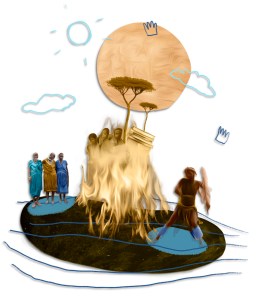 Last month, in Limbe, Cameroon, we had the Storytelling & Participatory Evaluation Retreat, named “Leveraging Indigenous Heritage for Participatory and Innovative Evaluation”.
 In this article I’ll present a tool designed jointly with Vanesa Castro and Valeria Sarmiento, members of the EvalParticipativa team, which was designed to help players participate in the review and critical analysis of a project, addressing the variables or feasibility factors that are most relevant to the intervention in question.
 At IDS (Institute of Development Studies, Brighton, United Kingdom) we are passionate about our rich legacy of participatory methods, and we believe that Participatory Action Research (PAR) and evaluation are more important than ever in the current context of complex and polarising challenges.