A Costa Rican experience of participatory evaluation that transformed perspectives and practices
by Karol Cruz Ugalde, Eddy García Serrano and Juan Murciano
 What happens when those who have historically been evaluated become co-evaluators? How can such a change be fostered, managed, and capitalized upon? Is it possible to promote participatory evaluation from within public institutions? How?
These were some of the questions that prompted us to write this chapter about the evaluation of the Program for the Promotion of the Autonomy of Persons with Disabilities in Costa Rica. We did not want to recount a technical process full of methodologies and results, but rather to share, from within, a living, challenging, and deeply human experience.
Within these pages, readers will find the Costa Rican context —a country with a legal framework that recognizes the rights of persons with disabilities, but which still faces great challenges in making those rights a part of daily life. Presenting this backdrop was essential, as it grounds the very purpose of our work: to show how evaluation can be a tool for transformation and democratic strengthening.
Two complementary perspectives
One feature that makes this chapter special is that it was written from two complementary perspectives. On one hand, Juan, as a consultant and teacher in participatory evaluation, accompanied the process through technical advisement and as a facilitator of evaluation capacity-building for people with disabilities and other involved stakeholders. On the other hand, Karol and Eddy, as evaluation managers at the Costa Rican governing agency (MIDEPLAN), contributed the institutional perspective of those who establish methodological frameworks, monitor the quality of evaluations, and receive final reports, but who are not directly responsible for the evaluated policies.
Combining both perspectives allowed us to view the process from within and from outside at the same time, bridging professional practice and public policy, the technical and the human.
-
- “Participatory evaluation taught us that looking from different places does not divide—it broadens understanding and multiplies learning.”
Participation as protagonism
From this confluence of roles, what we are most excited to share is how we conceived of participation within the evaluative process. It was not just a matter of consulting with beneficiaries or key stakeholders, but of recognizing them as rights-holders and protagonists, making strategic decisions.
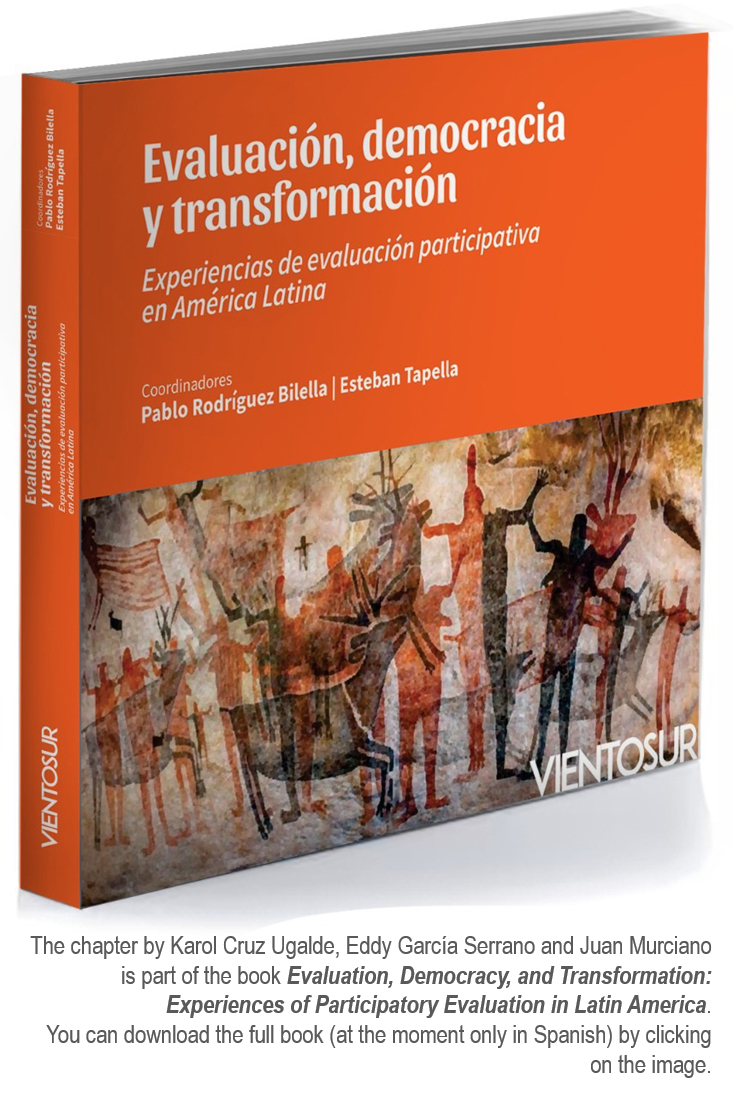 From the beginning, we sought to ensure that people with disabilities were not seen merely as “informants” but as co-evaluators, whose knowledge and experience could enrich the analysis and challenge the assumptions of public policy designers.
-
- “Facilitating this dialogue of knowledge among decision-makers, managers, and rights-holders is the essence and singularity of participatory evaluation.”
We were inspired by the motto “Nothing about us without us,” championed by disability movements around the world. That principle guided how we designed and managed the evaluation: not to speak about them or decide for them, but to build with them, side by side, each step of the process. The fertile ground for this was the participatory planning workshops—some of our most enriching professional experiences.
In the chapter, we recount how we built horizontal spaces for dialogue, some simple and others more structured, where conversation flowed freely. Configuring evaluation teams expanded with non-traditional actors was as challenging as it was rewarding. Readers will see how these voices formulated and redefined the questions to be answered, prioritized topics, and gave the evaluation a more democratic sense, re-signifying its political nature.
We also share the challenges: institutional resistance (the vertigo of losing control—or power), logistical and administrative limitations (how to bear the costs of participation for those who do not usually participate and must do so at their own risk, with the high opportunity cost that delving into their vulnerability entails), or the difficulty of sustaining real participation beyond the symbolic.
-
- “Participatory evaluation is not a linear path, nor is it free of contradictions, but in its tensions the deepest learning emerges.”
Among the most significant lessons learned, we highlight the need to rethink our own practices as evaluators, acknowledging that the most valuable results are not always in the final report, but in the processes of empowerment, reflection, and organization generated along the way.
A path of no return
 In writing, we sought to convey the emotion and pride we felt at having taken part in something much larger than a technical exercise. This chapter is also a testament to how evaluation can be a space for human encounter, mutual recognition, and collective construction of meaning. In our case, meaning in evaluation.
In the concluding phase of our account, we refer to a “path of no return“: once one experiences participatory and democratic evaluation, there is no going back. Thus, we dared to reformulate the initial slogan and say: “Nothing about us without you all”.
-
- “Participatory evaluation is not a linear path, but it is a path of no return.”
With this expression, we wanted to state that this process not only transformed the participants but also ourselves as evaluators. Today, we can no longer conceive of our work without such dialogue, openness, and collective commitment.
An open invitation
Anyone reading these pages will find a narrative that combines data, testimonies, and reflections, but above all, will find an invitation: to think about evaluation as an instrument for democracy and social transformation. We have purposely left some threads open, so each reader can ask themselves what it would mean to bring these practices to their own contexts. Ultimately, this chapter speaks about Costa Rica, yes, but it also enters into dialogue with many Latin American realities.
-
- “When evaluation opens itself to dialogue, it ceases to measure and begins to transform.”
We hope that, in reading this, not only information will be found, but also inspiration to believe it is possible to evaluate differently: more justly, inclusively, and participatively. In short, for a more democratic and transformative evaluation practice.