by Vanesa Castro & Esteban Tapella
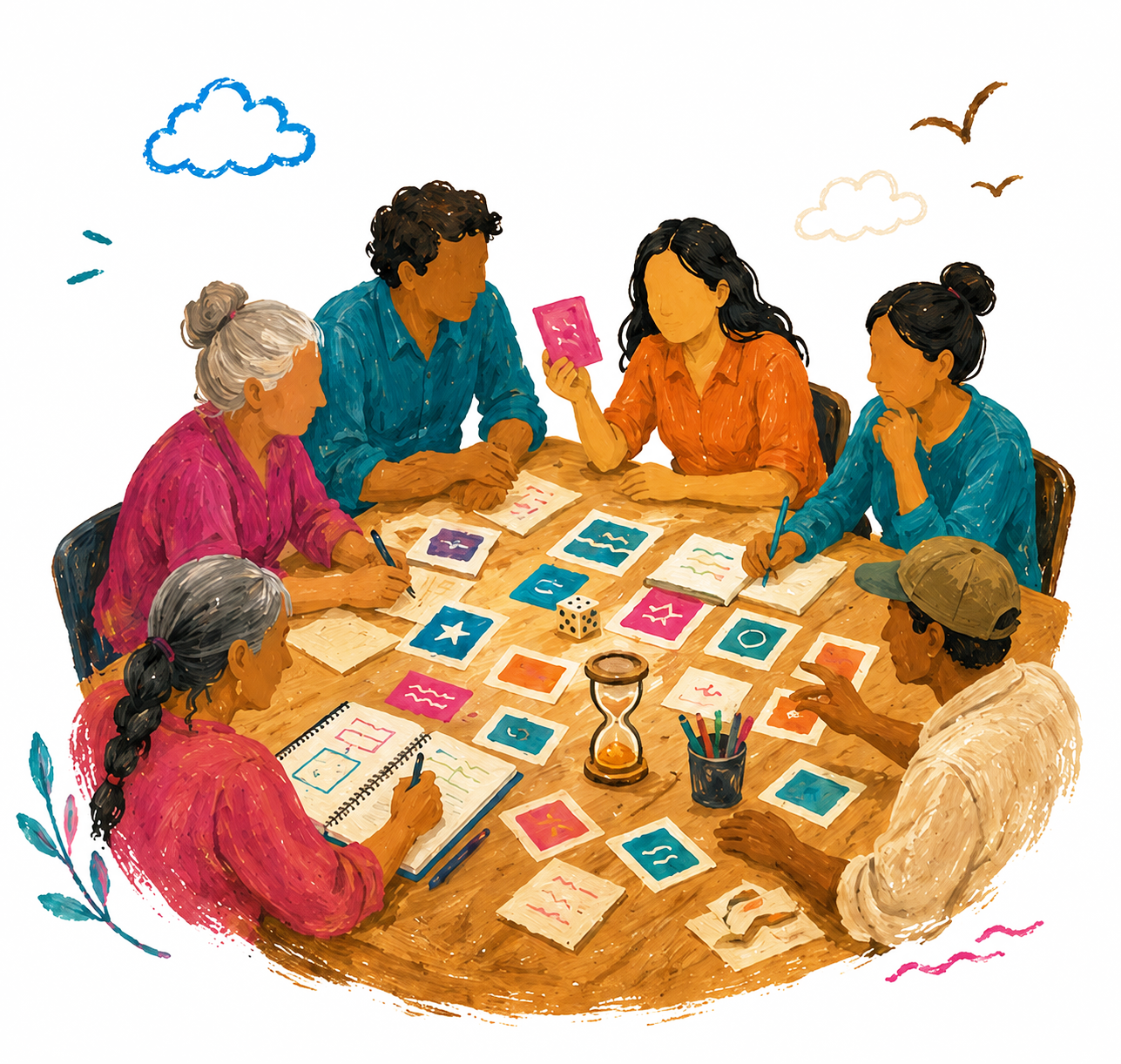 There are three weeks left before the workshop, and the table is covered with hand-cut cardboard cards, marker pens running dry, and a pile of post-its that have long since lost whatever order and meaning they once had. We are a group of colleagues trying, more or less by trial and error, to design the tool we will use to facilitate a participatory evaluation process. We don’t have it yet. What we do have is a question that won’t let us rest: how do we get the people we’re going to work with not just to answer questions, but to help build them with us?
We cut, cross out, cut again. Oscar, who has years of experience in this kind of work, looks at the cards scattered across the table and declares: “this isn’t going to work.” Nobody takes it as the final word. Belén picks the idea back up from another angle: “What if, instead of a closed statement, this card became a question?”
“What if we built something with dice?” Pablo suggests. “And what if, instead of dice, we used cards, and wrote a few of them as ‘trick’ cards — a bit misleading?” Valeria adds. “Trick them into what?” Oscar asks, still sceptical. “Into doubting, into questioning things,” Valeria replies. “So it’s clear that not everything a card says has to be true.”
And so, between crossings-out and rough attempts, something that isn’t yet a tool starts to take shape: little more than a sketch made from whatever is at hand. It begins as a vague unease, with only one certainty: conventional evaluation questions aren’t enough. We wanted something capable of sparking horizontal exchange and reflection, a device that would open up a discussion rather than close it down, that would push the group towards disagreement first and, with luck, towards some kind of consensus afterwards.
Nothing is set in stone yet
Experience has taught us that these early rough ideas are exactly that: ideas, a sketch of a tool. Over time we’ve learnt that you go back and forth between paper and testing until the technique takes proper shape and holds together. Part of the process is showing it to someone, usually a colleague going through the same kind of adventure. We explain the dynamic, hand over the draft printed cards, and ask them to play in earnest, as if it really were their own subject and their own life at stake. We push them to question it, to imagine whether it would work with the group and in the context it’s intended for. We ask them to go through the ‘trick’ cards and tell us whether any are too obvious, or whether an instruction is confusing. We also ask them to look at the timing, the instructions, and any possible variations.
Sometimes the ‘tool’ survives that first test with only minor changes. Other times it comes back to the table in pieces, and we have to think of something else entirely. If it survives, we take it to the workshop knowing that even there it won’t be the final version: we put it to the test once more, this time with the real group. We watch what happens, how the participants engage, whether the instructions are clear, and we adjust again. The whole process, then, goes through many rounds. What matters first is the content and the dynamic; the graphic design —colours, typeface, illustrations— comes last, once we already know the game works.
Other tables, other games
We like to think that, somewhere in Costa Rica or Nicaragua, back in the 1980s, a group of popular educators sat around a table much like ours. They too cut out little cardboard pieces and argued over whether a dynamic would “catch on” with the group or not. From tables like theirs came a book that later travelled through many countries and was reprinted so many times we’ve lost count: Técnicas Participativas para la Educación Popular (Volume 1 and Volume 2). No single person wrote it to a fixed plan. It was written, in effect, by hundreds of hands that kept testing, adjusting and reinventing it.
A little earlier, in Brazil, Paulo Freire had argued that people who live a particular reality are best placed to analyse it, question it and rethink it critically. There’s no need for someone from outside to come and explain it to them, he used to say: knowledge is not imposed from above, nor deposited into people, but built collectively through dialogue, experience and reflection on a shared world.
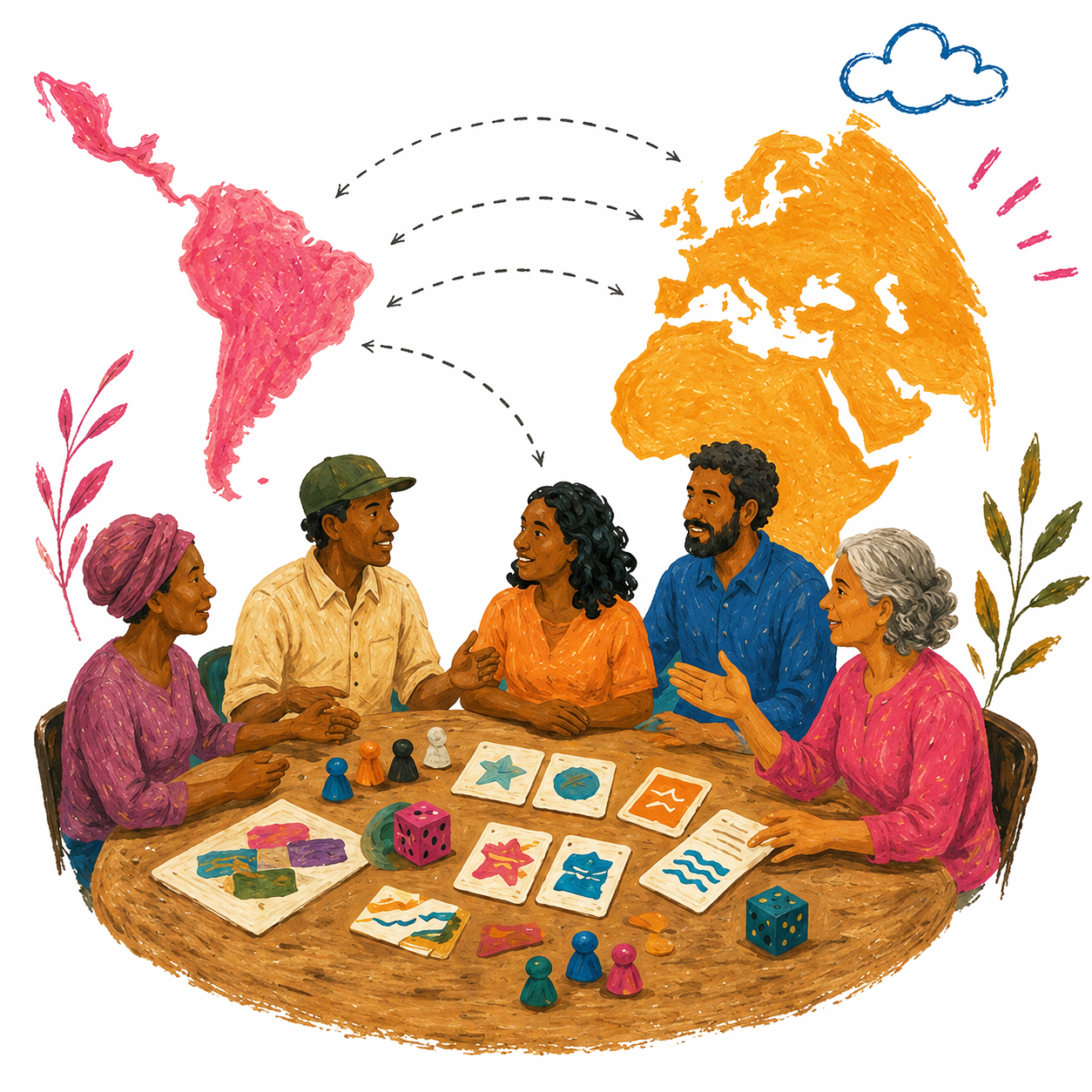 For his part, Orlando Fals Borda, in Colombia, wondered what would happen if knowledge were not extracted from people as an object of study, but built together with them, drawing on their experiences, their knowledge and their own ways of interpreting reality. For Fals Borda, research was not simply about observing or describing; it meant taking part, alongside communities, in a process of dialogue, reflection and action aimed at critically understanding the world and changing it.
In Brazil, Augusto Boal, a playwright and theatre director exiled during the country’s dictatorship, developed a repertoire of more than four hundred games and exercises for actors and non-actors alike. Through them, he sought to break down the divide between those who act and those who merely watch, and to hand the stage back to people who had never had the chance to stand on it. For Boal, theatre should not be limited to representing reality: it had to become a space for dialogue, participation and the collective rehearsal of other possible ways of changing it.
None of them would have said they were designing a serious game. That term was coined by Clark Abt in the 1970s. Abt, an American researcher, was thinking about how to better train officials and decision-makers, and he set the idea down in his book Serious Games (1970). A serious game, he wrote, has “an explicit and carefully thought-out educational purpose,” and is not meant to be played purely for fun. It’s a line we could happily sign up to, although it doesn’t quite capture what happens at our table when we’re dreaming up a game. What we’re after isn’t simply for someone to learn something we already knew in advance: we want the group to arrive somewhere that we, as outsiders to the community, could never have reached on our own.
Seven principles behind the board
This legacy is not just a bit of colour, or a quaint genealogy to cite for effect. It is what gives our own work its identity, beyond the little cards, the dice or the hourglass we tend to use. It’s worth recalling one milestone from our own journey.
In Quito, in 2019, a group of colleagues from across the region came together to pool decades of experience in participatory evaluation. One of the aims was to build, from reflection on that shared experience, a conceptual and methodological framework for participatory evaluation across the region. And so, at that first Retreat on Participatory Evaluation Experiences in Latin America and the Caribbean, a set of principles was drawn up to guide the practice of an inclusive, plural evaluation.
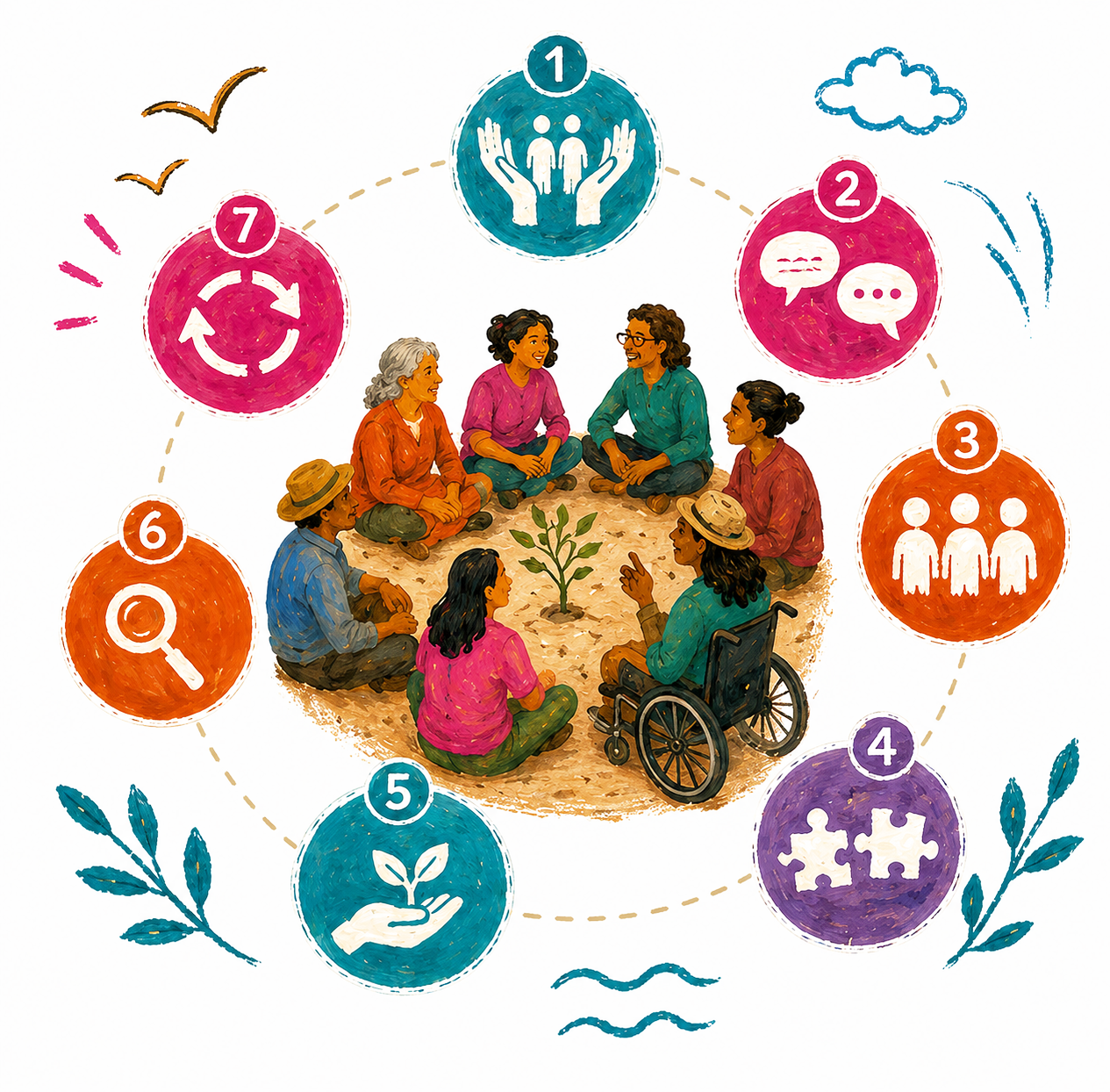 At that meeting it was agreed: (1) that people living through the intervention should be treated as rights-holders, not merely as informants; (2) that local knowledge should count as much as technical knowledge; (3) that institutions should work in partnership with local actors, not above them; (4) that technique should exist to facilitate dialogue, never to replace it; (5) that the group should take ownership of both the process and its results; (6) that evaluation should leave behind installed capacity, not just a report; and (5) that whoever facilitates the process should support and guide collective reflection, promote dialogue, draw out participants’ knowledge and experience, help problematise reality, and create the conditions for the group to build its own conclusions and recommendations.
At EvalParticipativa, we gave this practice of ours a name: games for thinking. It’s the term under which we have been systematising, for several years now, this way of designing and using games for participatory evaluation across the region, set out in the manual Sowing and Harvesting (Tapella et al., 2021), and one that keeps growing with every new tool we build.
We didn’t invent this from scratch, and this table isn’t the first one. EvalParticipativa’s Toolkit already holds several games for thinking, each born out of real-world processes: La Chiva (‘the local bus’), which started life at Colombia’s Ministry of Agriculture; the Mitos y Creencias sobre el Cáncer (‘Myths and Beliefs about Cancer’) game, designed for an evaluation in Costa Rica; and the Dado Preguntón (‘Question Dice’), which helps a group put its own project’s theory of change into words. Each one was born at a table just like this one.
After several years travelling this creative path, we feel that no worthwhile game for thinking can afford to ignore these seven principles. They are, at bottom, what underpins every board and every card we cut out.
The same question, in another language
We recently learnt that the European Evaluation Society’s conference —to be held this October in Lille, France— will include a workshop devoted to games as a tool for strengthening evaluation capacities. It’s heartening to see that playing and evaluating are not mutually exclusive, and that this is not some Latin American quirk: in contexts quite different from our own, other colleagues are thinking along similar lines.
But the news also leaves us thinking about the similarities and the differences. Over there, when people talk about a “serious game,” they tend to think of it as a device for teaching content, checking whether something has been retained, or testing a causal mechanism. It’s a valid logic, but a different one from what drives our table full of cardboard, boards and little cards. Perhaps that’s the real nuance we want to draw out: they design a serious game; we prefer to invite people to “play in earnest.” Building a game around a fixed educational purpose is not the same as inviting a group to genuinely put their own view of what they’ve lived through on the line.
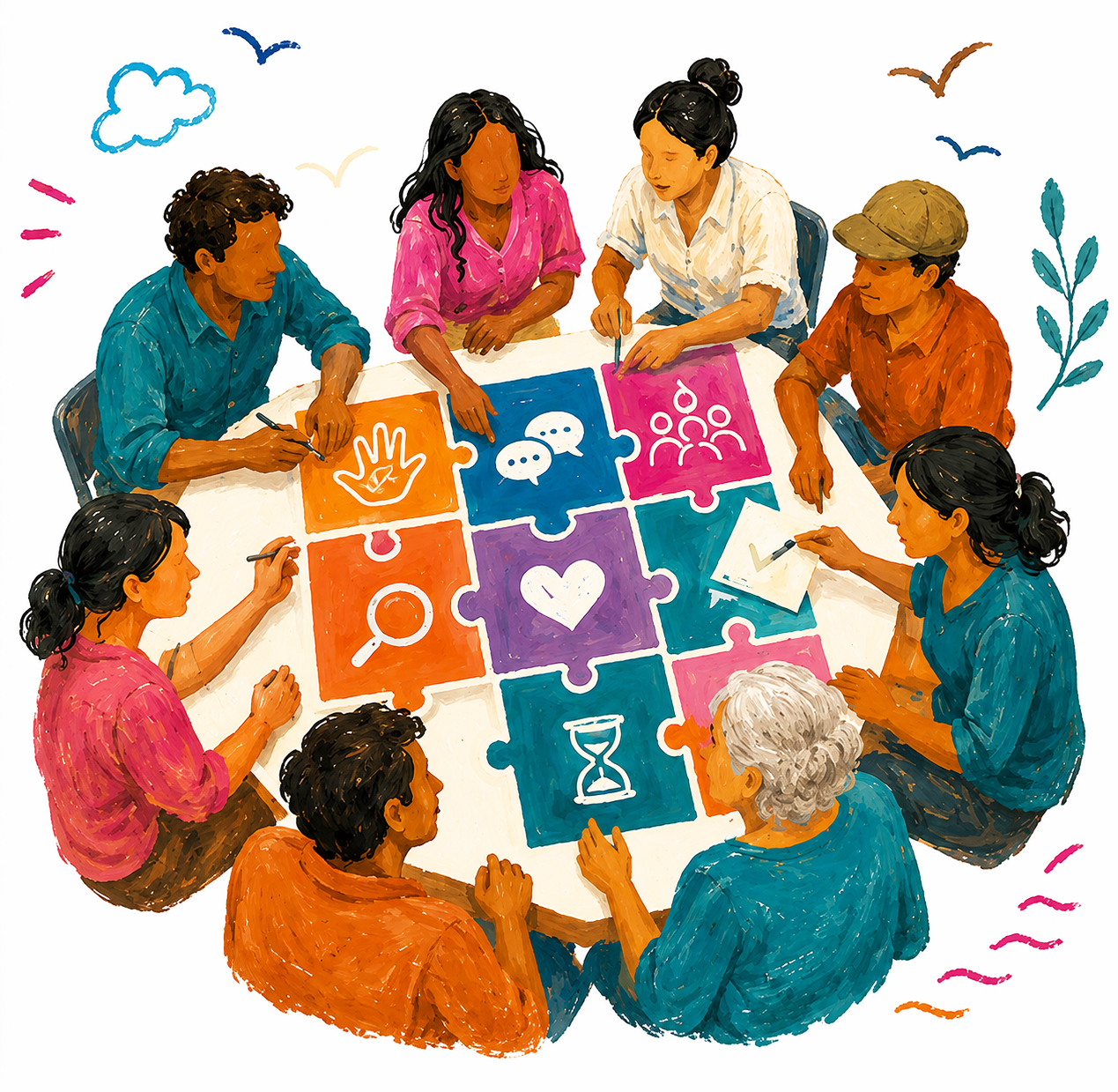 One clarification is worth making here, because the word “game” can easily cause confusion. We are not talking about icebreakers, introductions, or ways of easing the mood between sessions —legitimate uses, but different ones. Nor is it about each participant playing a role that isn’t their own, as a way of escaping into some fantasy world. Games for thinking ask for quite the opposite: that each person play their own part, bringing their own experience, knowledge and point of view to the table, and put them —quite literally— into play alongside everyone else’s.
Is this simply a difference of emphasis? Or are there, in fact, two quite different ways of understanding what a game for thinking is ultimately for?
For us, games for thinking aim to tackle complex issues in a participatory, horizontal and non-imposing way, drawing together knowledge, experience, opinions and personal decisions. We want them to be an instrument capable of recreating, as faithfully as possible, the situations and conflicts of everyday life, of work, of organisations and of society, inviting people to take on an active role and, as we like to say, to “play in earnest.” Their rules and their dynamic encourage communication and the expression of experience, knowledge and expectations, and allow groups to tackle, collectively, issues that would otherwise be difficult to address. The challenge, ultimately, is to support learning and organisational development by making these processes more engaging, participatory and democratic.
Open questions
We still don’t know whether the game we’re putting together this week will actually work. It may be that someone falls silent during the first trial run, that the dynamic feels forced, or that the ‘trick’ cards turn out to be too obvious and nobody falls for them. We’ll try it out, watch each other, and correct things as we go along —just as this tradition we’ve inherited, without ever setting out to, has always been corrected.
And yet, even though we don’t yet know whether this card or that die will work, we are clear about what we are not looking for. We don’t put these games together to check whether someone has retained a piece of content, or to confirm that a message has landed as intended, or to test whether some causal mechanism has played out exactly as we planned on paper. That kind of checking has its place and its value, but it isn’t ours. When we build a game for thinking, we’re betting on something else: that the board, the cards and the rules become a legitimate excuse for a diverse group (with its hierarchies, its silences, its disagreements) to share what it knows, what it has lived through, what it thinks and what it decides, and, from there, to build together a reading of the programme or project that none of them could have arrived at alone.
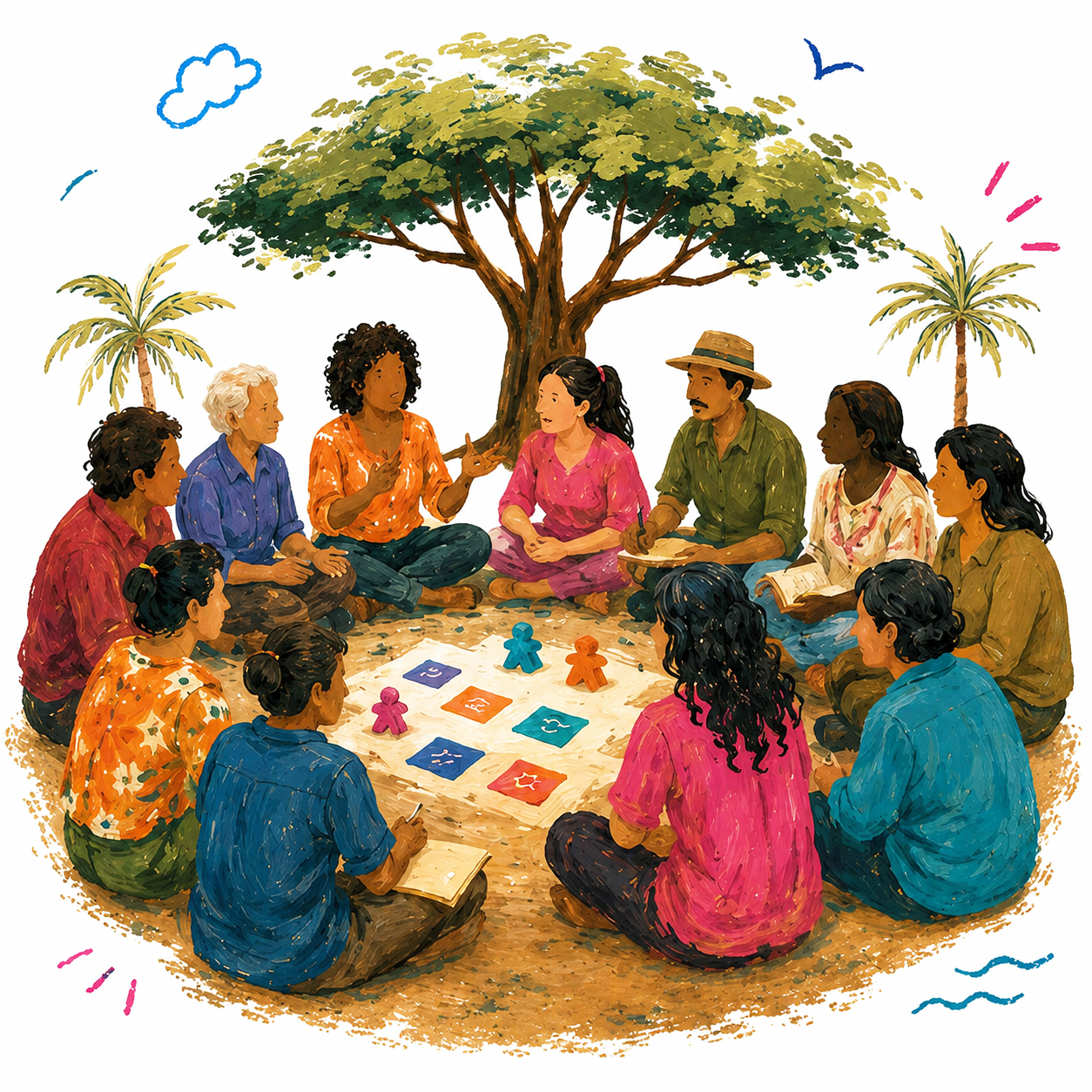 That is why we insist the game be participatory, horizontal and non-imposing: there is no correct answer hidden beneath the card, waiting for whoever plays best to uncover it. Instead, there is an open question that each participant completes with their own experience, and which the group finishes answering together. The ‘trick’ card is not there to catch anyone out: it’s there to open up doubt, so that each person feels able to say what they think, even if it contradicts what the card says or what the last person argued. That, at bottom, is the kind of knowledge we’re interested in producing: one that brings together technical knowledge and lived knowledge, opinions and personal decisions, and that is built through dialogue, not in ‘exam mode.’
So, one question keeps turning over in our minds —the same one we began this piece with: when we set a group of people playing in order to evaluate a programme or project that affects them, what are we really looking for? Each person’s individual understanding, or the possibility that, together, a fuller picture might emerge —a new perception that goes beyond the sum of its parts?
This is as far as we go for now. Like the cards laid out on the table, we leave this question open for further reflection with those who wish to join us.